
Transition Is Personal. The Conditions Are Structural.
What happens inside a person during transition is intimate. Whether they have the time, money, language, relationships and coordinated support to navigate it is shaped by the conditions surrounding them.

At 9:07 a.m., an email can eliminate a title, a paycheck, health insurance, a daily routine and the community someone thought they would see every Monday morning for years.
By noon, that same person may be expected to update a resume, file for unemployment, compare health plans, reassure their family, explain what happened to five different people and begin performing optimism on LinkedIn.
A diagnosis can turn a familiar body into unfamiliar territory. A divorce can end not only a relationship, but a home, a budget, a social circle and the future someone assumed they were building. An empty nest can fill a house with a silence no one prepared a parent to hear. A crisis of faith can leave someone standing in the same community while no longer recognizing the beliefs that once organized their life.
These experiences are deeply personal.
But whether transition becomes a supported passage, a prolonged period of harm or a private emergency depends heavily on the conditions around the person living it.

What Happens Inside a Person Is Personal
Transition moves through the body before it ever becomes a plan.
It can look like interrupted sleep, a racing mind, physical exhaustion, grief, shame, irritability, numbness or the inability to make one more decision. It can disturb the roles and relationships that helped someone understand who they were. It can make an intelligent, capable person feel strangely unable to complete tasks that once seemed ordinary.
I know this because I have lived it.
When I stepped away from higher education for an unpaid mental health sabbatical, the visible disruption was professional. The actual transition reached into my finances, body, relationships, home, creativity, sensuality, sense of purpose and trust in the institutions and definitions of success I had been taught to follow.
From the outside, it may have looked like I had left a job and needed to determine what came next.
Inside my life, almost everything was being renegotiated at once.
That experience helped me recognize something we rarely name clearly: the event that begins a transition may happen in one area, but the consequences rarely remain there.

People Do Not Live in Silos. Support Systems Often Do.
Some exits are chosen and some choose you. Then comes the in-between. The old life no longer aligns, the next life has not yet taken shape, and every decision seems connected to five others.
Even with all of this, one office handles employment. Another handles housing. A separate provider handles mental health. Someone else manages benefits, healthcare, education or retraining.
Each comes with a different portal, set of forms, eligibility rules, vocabulary and request to explain what happened.
At the exact moment someone may feel least clear, they are expected to diagnose their own needs, identify the correct institution, understand its language, prove they qualify and make decisions that could shape the rest of their life.
They are asked to coordinate the support system while simultaneously surviving the reason they need support.
These organizations may be doing precisely what they were designed to do. The problem is that human lives do not separate themselves according to departmental responsibilities.
The person trying to replace lost income may also be losing sleep. The person leaving a marriage may need housing, legal information, emotional care and a new relationship with money. The educator questioning whether she can remain in the profession may also be grieving an identity, worrying about healthcare and trying to imagine how her knowledge could matter somewhere else.
We call people resilient while asking them to perform the work of an entire ecosystem alone.
The question is not only whether resources exist. It is how much clarity, health, time, money, digital access, literacy and emotional steadiness someone must already possess to find and use them.

Agency Needs Somewhere to Stand
Naming structural conditions does not mean people have no agency. It means agency needs somewhere to stand.
Telling someone to trust themselves is not the same as helping create conditions in which they can hear themselves. A person may need rest, accurate information, material support, a safe place to live, relationships that can hold the truth, room to experiment and enough time to make a decision without one imperfect choice becoming catastrophic.
Internal authority and external support are not opposites.
We need both.
This is part of what I call Abandoning Self-Abandonment: learning to recognize where survival, belonging or responsibility have trained us to leave our own knowing behind, without pretending personal insight alone can resolve material conditions.
This is also why practices such as reflection, movement, nature, sound, storytelling and creative expression matter. They do not replace healthcare, income, housing or other material needs. They can, however, help someone find language for what is happening, reconnect with their own perception and participate more fully in decisions about their life.
The goal is not to remove every uncomfortable feeling from transition. Discomfort may be part of releasing an identity, relationship or way of living that can no longer hold us.
The goal is to stop making that discomfort more punishing, isolating and prolonged than it needs to be.

A More Humane Question
Our culture often asks people in transition, “What are you going to do next?”
That question can arrive before someone has had space to understand what ended, what changed or what their life is asking of them now.
More humane questions might be:
What is true for you right now?
What part of your life deserves care first?
What part of your life could help support the repair?
What are you carrying that is yours to address?
What have you been blaming yourself for that may belong to the conditions around you?
What information, relationship or material resource would make your next decision less costly?
What do you need to borrow until your own clarity returns?
For families, friends and communities, support may begin by replacing “What is your plan?” with “What would help this feel less impossible?”
For institutions, it may mean asking how much labor people must perform to receive the help being offered, where systems contradict one another and how support could be coordinated around a whole human life rather than a single presenting problem.
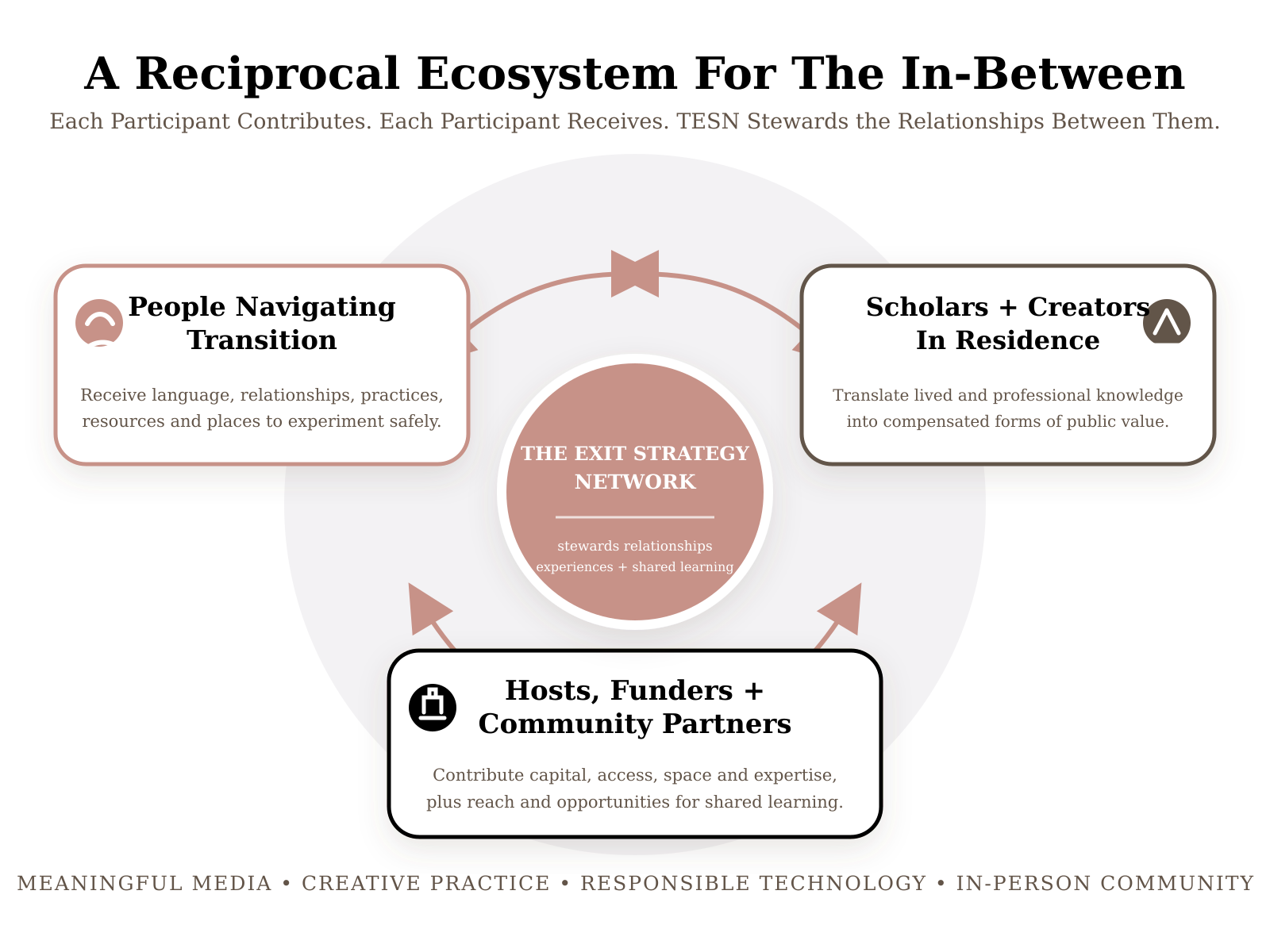
What I’m Testing Through The Exit Strategy Network™
The Exit Strategy Network™ is emerging from this inquiry.
We are exploring how meaningful media, creative practice, whole-life learning, responsible technology, community gatherings and Scholar/Creator-in-Residence partnerships might help people navigate the place between no longer and not yet with more language, connection, material support and room to choose.
We are not building another platform that announces the correct next step.
We are asking what could help a person notice what is true, identify what deserves care, encounter relevant people and possibilities, experiment safely and decide again.
That means listening before overbuilding.
It means learning from people living through different forms of transition, from impact professionals translating what they have lived and learned into public value, and from institutions willing to examine whether their current approaches are genuinely helping people move toward wholeness.
The exit may be personal.
The conditions of the passage are something we create together.
And if we want different human outcomes, we have to build environments, relationships and systems capable of supporting them.
If you are navigating the place between no longer and not yet, your experience can help shape what we test. Join the Listening Cohort.

Hi, I’m Ms. Marisha. I’m an educator turned Creator-in-Residence, Social Practice Artist, and Founder of The Exit Strategy Network™ .
I partner with brands, schools, cities, communities, and institutions ready to move beyond content and build regenerative culture through storytelling, enrichment, experience design, and community-centered strategy.
Explore my background
Read more on Creator-in-Residence
Watch my news clip
Let’s connect on a discovery call
