
Please, BARE With Me
My intention for this space is to serve as an invitation to embrace vulnerability and creative expression as a source of strength.
I’ve wrestled with doubt, detoured through uncertainty, and found solace in therapy, solitude, and nature. These experiences taught me that transformation isn’t about perfection—it’s about showing up, embracing the unknown, and honoring the stories that shape us.
My enrichment offerings and writings are my way of sharing that truth and inviting others to join me in building a more thoughtful, expressive, and connected world.
Let’s explore what it means to live boldly, out loud, together.
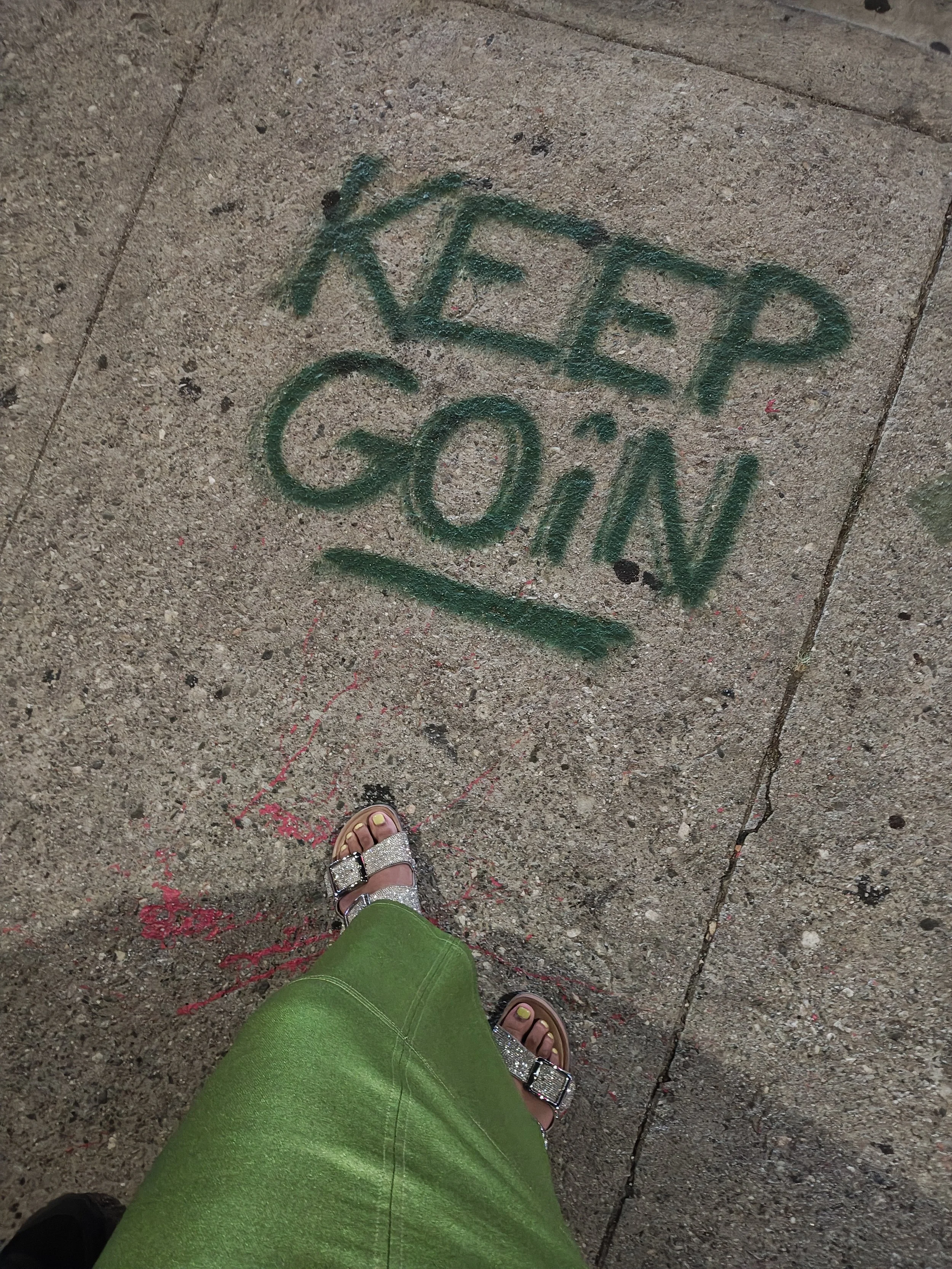
There Is No Syllabus for This Part: A Morning Walk Download on Self-Authorship, Old Rubrics & Learning to Trust a Path Still Being Paved
None of us are required to stand at the beginning of a nontraditional path and somehow possess the retrospective clarity people usually acquire only after they’ve walked it.

I caught myself doing something on my walk this morning that I thought I had gotten better at.
I have a tendency of trying to make my life make sense from the outside, even if it has all come fully into form or clarity for myself.
I was smiling thinking about everything currently moving at once…the art, media projects, applying to residencies and fellowship programs, building out my Creator-in-Residence model and the platform for The Exit Strategy Network.
At some point, the joy of it all turned into a familiar little tension and a taunting voice, “Does this all make sense? Would someone else even understand this? Aren’t you doing too much? Would one thing make another thing look less serious? Was there some cleaner version of this path that I should be following instead?”
I stopped under some trees to take a few breaths and pause the noise.
Eventually that pause helped me make sense of what I was doing. I was trying to evaluate my nontraditional life using a traditional rubric. It was kind of silly after that clarity hit me. For most of our lives, someone else supplied the instructions for how to get through things.
School provided the syllabus and someone else decided what we needed to learn, when we needed to learn it, what the assignment would be and how well we had performed.
Then we enter the workforce and the structure changed names but not necessarily form. There were job descriptions, key responsibilities, deliverables, KPIs, performance reviews, promotions, etc. Somebody still had a framework for what counted.
But now, I’m in a season where much of that external scaffolding is gone.
After exiting the life I knew, it took a while to adjust and realize there is no syllabus for this part. There’s no professor standing at the front of the room saying, “Yes, Marisha, these six seemingly different interests do in fact belong together.”
There’s no manager telling me which experiment deserves thirty percent of my attention this quarter, no rubric confirming that taking a walk instead of forcing another hour of work might actually be the more productive choice.
There’s no job description telling me that an idea which becomes a piece of sound, another that becomes an artistic experience and another that becomes a company can all come from the same person without making her unfocused.
It took time to discern that, but apparently, some mornings, I have to still remind myself, which is partly why I walk.
Walking creates enough distance between me and whatever I’ve been staring at to hear something other than the urgency of the task in front of me. I don’t go out there demanding an answer, I simply walk. I look around, greet the animal and plant life along my path, let my body move, and just become receptive.
And almost like clockwork, the thing I’ve been trying to think my way through finally has enough quiet to introduce itself differently and this morning the reminder was simple:
Run YOUR race. Play YOUR game.
My dad would always say that to me during my track meets or basketball games. It was his way of reminding me that I have practiced and I have my own rhythm so find my flow despite whatever’s going on around me. And after processing that, something else surfaced. I was reminded that with all the things I’m doing, the outputs may not look alike but that doesn’t mean the throughline isn’t real.

When I move beneath the surface of what I’m building, my patterns, my process becomes clear and consistent.
I witness or experience something that either bothers, fascinates or stays with me for whatever reason, then I start to notice a gap. I internally begin asking questions and pull from what I’ve lived, studied, taught, created or observed to imagine other possibilities. Then I try to give that possibility form. Sometimes the form is conversation, other times it becomes a piece of writing, an educational resource or curriculum. Sometimes it’s an experience, and recently it’s become art, media and a startup.
The form changes. The intelligence of my own process underneath it doesn’t.
As I started reflecting on the last two years, it became evident that this is one of the things this season is trying to teach me. Coherence and sameness are not the same thing. A life can be coherent without being easily categorized. A body of work can have continuity without every piece belonging to the same industry. A person can be serious about multiple expressions of the same underlying inquiry, and a path does not automatically become irrelevant simply because no institution has already created a title for it.
I think part of what I am unlearning is the belief that uncertainty means I am doing something wrong.
Sometimes uncertainty is simply what it feels like to be somewhere before the evidence catches up with the intuition.
This doesn’t mean intuition is always correct, but that’s the point of researching, testing, documenting, inviting feedback, intentionally seeking out relationships and rooms where there is support, structure, and resources for experimentation.
I’m not replacing rigor with vibes, but I am learning that alignment is not the absence of effort. It determines where my effort belongs.
But finally embodying that understanding has required a discipline of deep listening when I would normally override myself, resting before depletion makes the decision for me, taking seriously the environments in which I think well, allowing pleasure, relationships, movement, money, health, creativity and contribution to all count when I evaluate whether something is actually working.

The point of this season is to build evidence instead of demanding certainty, which is why my life feels so different.
For the first time, I’m not simply trying to figure out what I can do professionally. I’m trying to understand what conditions allow me, the human being, to thrive and what kinds of opportunities become possible from there.
There is a difference.
So when that old urge returns, the one that wants the entire architecture explained, validated and legible before I allow myself to keep walking, I try to remember that I do not have to prove the whole vision today. I only have to build the next piece of evidence.
None of us are required to stand at the beginning of a nontraditional path and somehow possess the retrospective clarity people usually acquire only after they’ve walked it.
You’re walking it! I’m walking it! And that’s likely why I heard my dad’s voice on my walk this morning, “Run your race, Marishaaa!!” It was just a little reminder that I have my own pace and process and to just lock in to that while blocking out everything else.
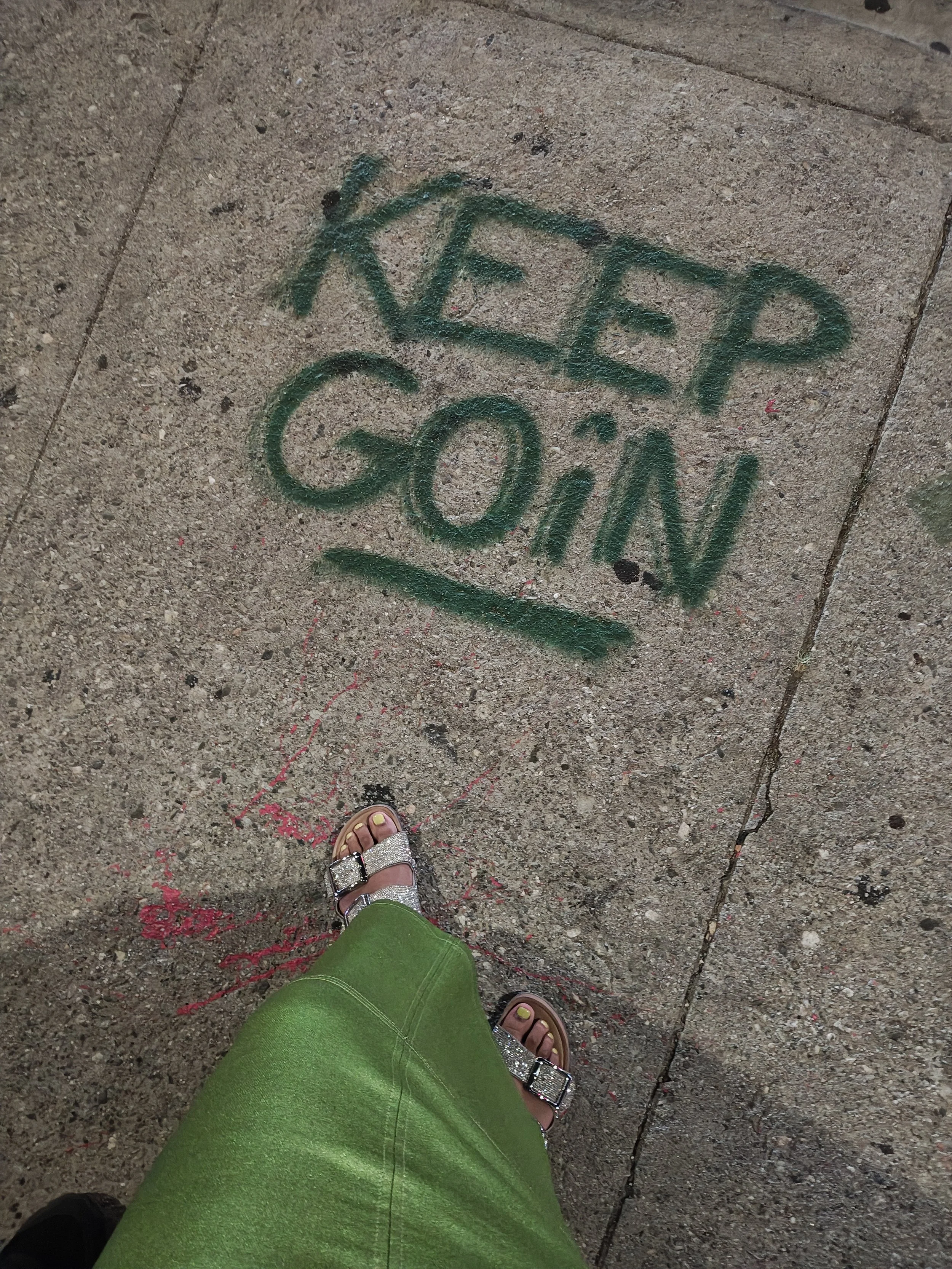
My priority lately has been to document the trail because when I think about my life, both personally and professionally, that documentation usually becomes a roadmap for me and eventually someone else to benefit from later.
Today, it was simply the reminder I needed to keep going.

Hi, I’m Ms. Marisha. I’m an educator turned Creator-in-Residence, storyteller, and founder of The Exit Strategy Network.
I partner with brands, schools, cities, communities, and institutions ready to move beyond content and build regenerative culture through storytelling, enrichment, experience design, and community-centered strategy.
Explore my background
Read more on Creator-in-Residence
Watch my news clip
Let’s connect on a discovery call
The Work Was Always There, The Environment Wasn’t: What Stepping Outside Institutions Taught Me About Building a More Self-Authored Way to Contribute
I used to think a coherent career was one that moved predictably from title to title. Mine didn't.
What I couldn't see while I was busy working inside extractive systems was that professional continuity can live somewhere other than a resume. It can live in the questions you keep asking, the functions you keep performing, the problems you keep noticing, the ways people repeatedly come to you for help, and the creative methods you reach for even when nobody has assigned them to you.
My career has become much more coherent now that I’ve stopped organizing it by title and started organizing it by throughline.
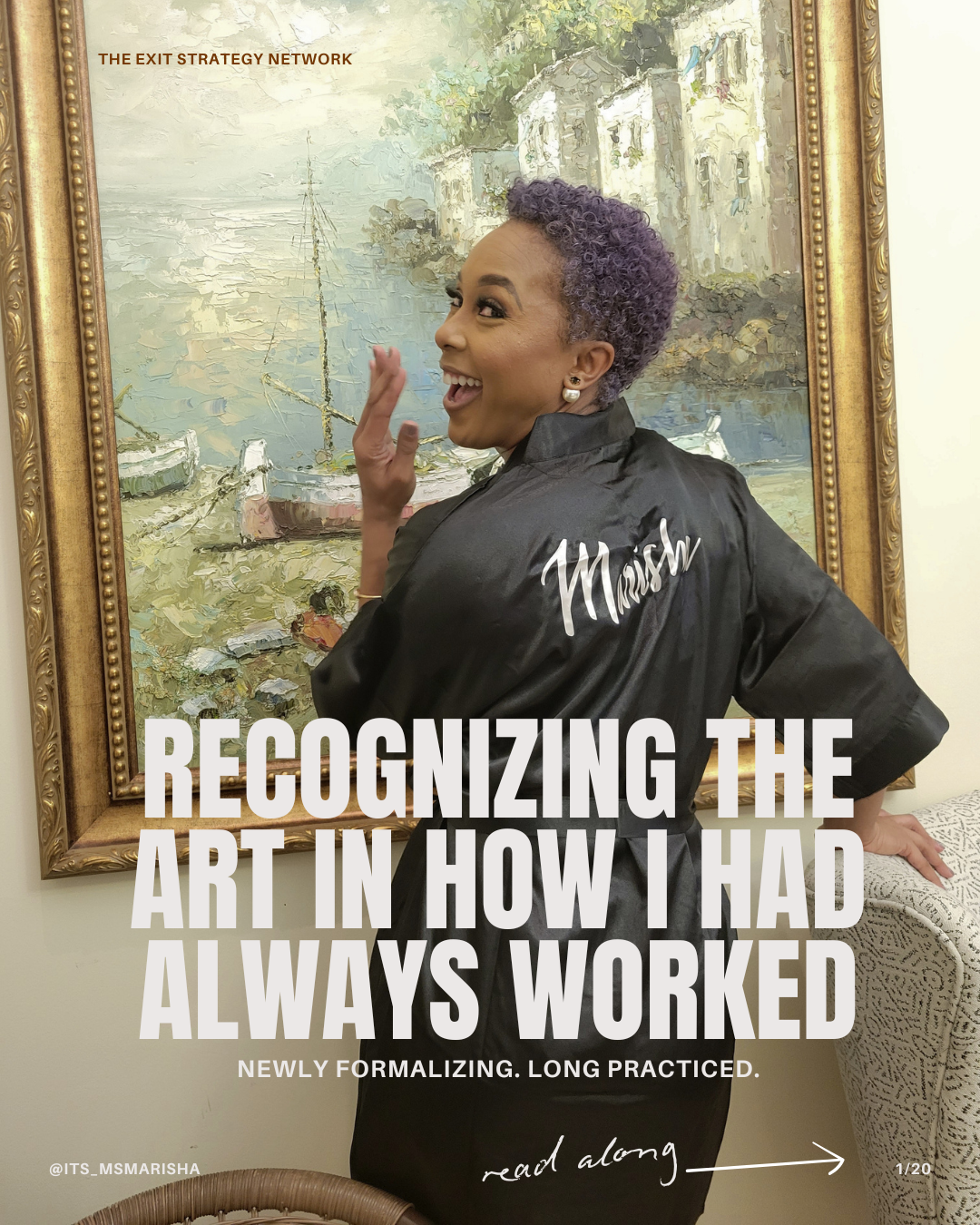
I used to think a coherent career was one that moved predictably from title to title. Mine didn't. What I couldn't see while I was busy working inside extractive systems was that professional continuity can live somewhere other than a resume.
It can live in the questions you keep asking, the functions you keep performing, the problems you keep noticing, the ways people repeatedly come to you for help, and the creative methods you reach for even when nobody has assigned them to you.
My career has become much more coherent now that I’ve stopped organizing it by title and started organizing it by throughline.
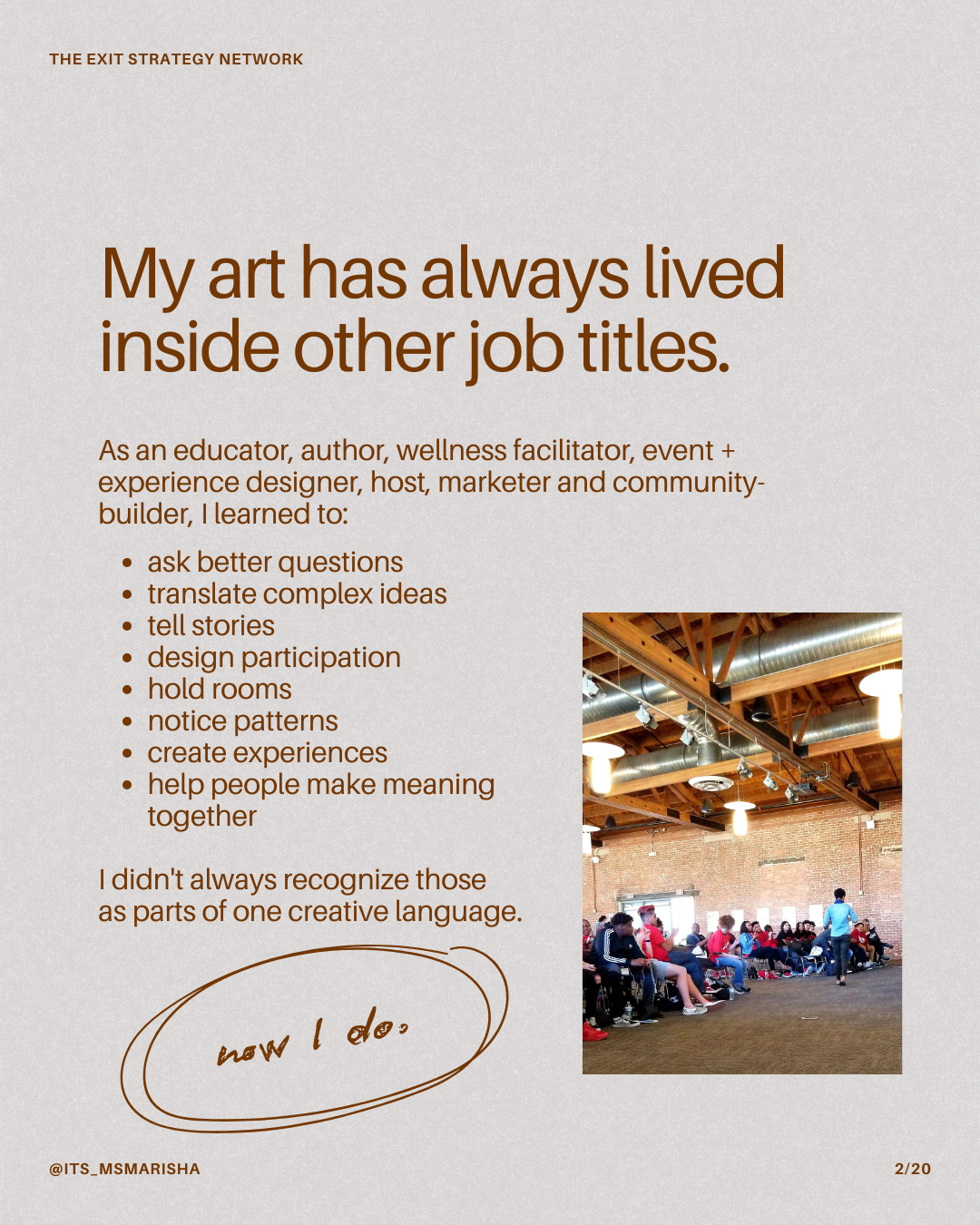
There’s a strange thing that happens when you spend enough years becoming good at your job. Eventually, the title can become so effective at describing where you work that it starts obscuring what you actually know how to do. I was a teacher. Then I wasn't. I worked in:
Nonprofit program consulting and strategic partnerships
Afterschool program development
Interviewing
Marketing and recruiting
Event and video production
Admissions and outreach
Matchmaking, coaching, and content creation
Wellness advising, program development, and facilitation
Higher education
Social enterprise development and project management
Community-building.
Creative direction
Writing.
For years, I understood those as different chapters of my resume. It took leaving the institutions and freelance world that housed much of that work for me to recognize that I had been asking similar questions and performing similar functions almost everywhere I went.
That realization has changed the way I think about career transition.
Sometimes Distance is Data
I used to think stepping away from my professional life meant I was losing momentum.
What I gained was perspective.
When there was no department telling me my responsibilities, no job description determining which skills were relevant and no institution organizing my time and compensation around its priorities, I had to ask a different question:
What do I keep doing when no one is assigning it to me?
I notice patterns, listen for contradictions, and I become curious about what people can't quite name. I look at what a system says it provides and what the humans inside it are actually experiencing. In almost every role, I translate complicated ideas, connect disciplines that don't always talk to one another, and then I start imagining what could fill the gap.
That showed up when I taught, when I interviewed people, in matchmaking, in boardrooms where I facilitated wellness programs and it showed up in media, events, my book and community experiences.
The subject changed, but the function didn't.
That’s an important distinction for anyone navigating a professional transition because a career can look nonlinear when organized by title and incredibly coherent when organized by function.
Job titles are containers, not the totality of our value.
This matters particularly for people whose work has been relational, educational, cultural or service-oriented.
Teachers often know how to facilitate, translate, observe, design experiences, communicate across differences, manage a room, understand audience needs and turn complexity into something usable
Social workers understand systems, behavior, story, community, crisis and human motivation
Health professionals carry enormous amounts of knowledge about mind/body, how to cultivate trust, behavior change and lived human experience
Community organizers understand participation
Nonprofit leaders understand mobilization
Researchers understand inquiry
None of those abilities disappear because someone leaves the institution where they first practiced them, but most of us were never taught to separate the function from the container. We were taught to look for the next title.
I'm becoming more interested in another question:
What else can what you know become?
This is why the Creator Economy interests me
If you’ve been following my recent content on social media, you’ll notice I’ve been discussing creator degrees being formalized at universities, multidisciplinary artists securing residencies, and other creator economy related topics. But this isn’t because I believe the future of work is everyone dancing into a ring light.
The interesting part to me is permission and infrastructure.
We are watching institutions experiment with forms of contribution that don't fit as neatly inside conventional professional categories.
USC named Solange its first Scholar-in-Residence at Thornton, with a three-year role that includes curricular and programmatic development around her multidisciplinary expertise. (USC Thornton School of Music)
UCLA has built artist-in-residence work with Keke Palmer that connects her creative practice, ownership philosophy, mentorship and KeyTV distribution ecosystem to students. (Creative Intelligence is the New Essential)
Starbucks went outside the conventional marketing-team structure and hired full-time Global Coffee Creators whose job is to immerse themselves in coffee, culture, community and place and tell the brand's stories from inside that experience. Starbucks itself has described the program as evidence of the evolving role creators play in brand storytelling, not simply another content initiative. (About Starbucks)
A Create-it Studios pilot inside a Walmart Supercenter in Franklin, Tennessee has added podcasting, recording, video, live-production and workshop infrastructure to a physical retail environment. A place designed primarily to sell goods can now also function as a place where people learn and make things. (My LinkedIn post)
And we've watched social-first creators like Reesa Teesa demonstrate that a story initially shared directly with an audience can become the proof for something more durable: publishing, intellectual property and a business life beyond the original platform.
I don't think these examples represent one new profession. I think they represent a much larger question:
What happens when organizations stop assuming valuable knowledge only enters through traditional employment structures?
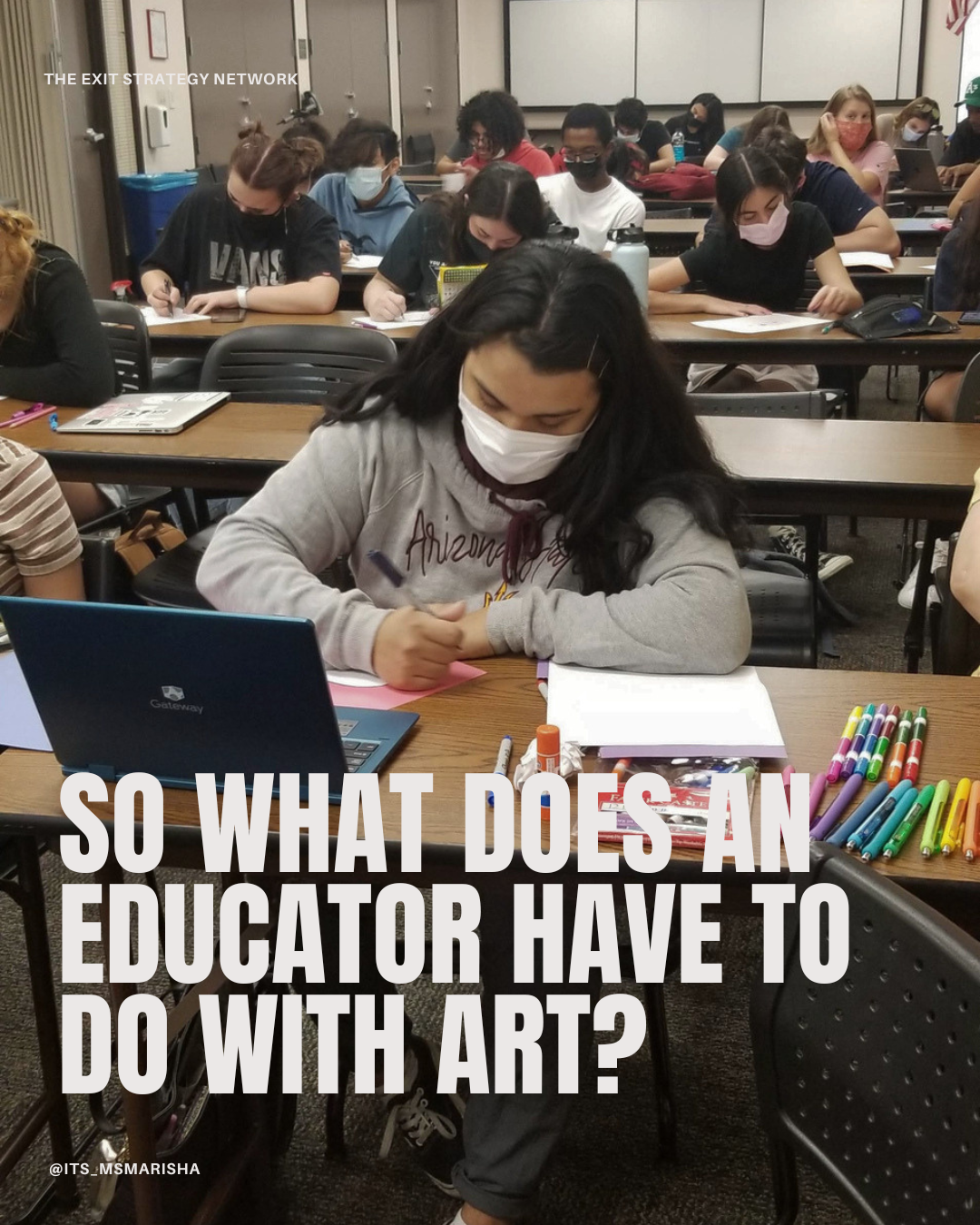
The Creator-in-Residence model is my answer to part of that question.
A Creator-in-Residence is interesting to me because it provides a bridge between two sets of assets that are usually separated:
The individual carries experience, perspective, expertise, creative intelligence, cultural fluency and a relationship to a question.
The organization carries resources, infrastructure, community, distribution, place, credibility and capital.
Neither side necessarily needs to become the other.
The artist doesn't need to become the marketing department. The educator doesn't have to become an employee. The organization doesn't have to build an entirely new internal function. Instead they can ask:
Where does what this person knows intersect with something our community genuinely needs?
That intersection might result in media, but it might just as easily result in a workshop, an installation, a listening experience, curriculum, a story archive, a community conversation, a guided practice, a research inquiry, a live event, a residency, a resource people continue using after a campaign would normally be over.
That is why I keep saying that Creator-in-Residence is not another name for content creator. Content may be evidence of the work, it may distribute the work, it may even help people discover the work, but the actual product is deeper: human insight translated into public value.
A residency gives an organization access to a practice not merely a deliverable.
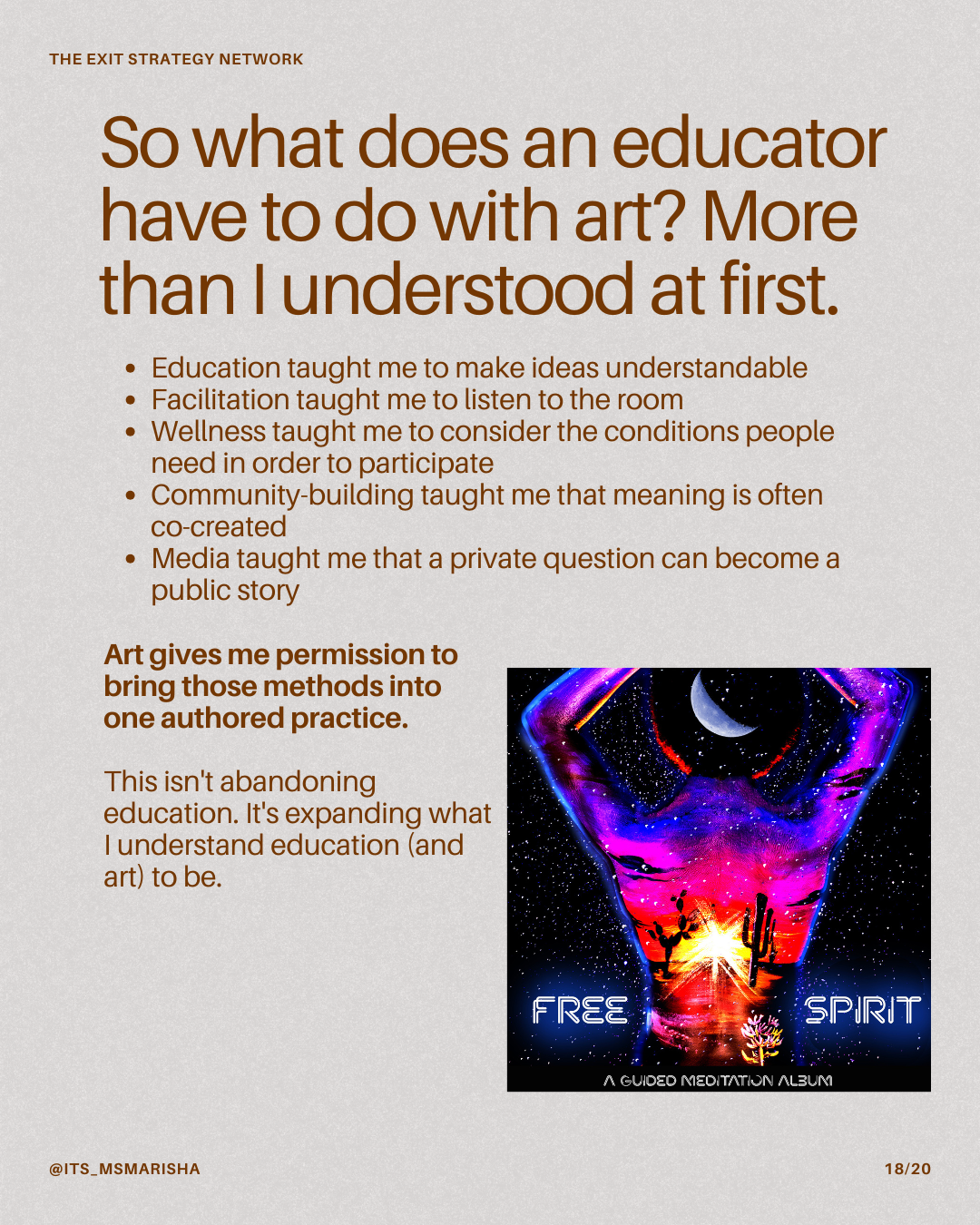
I'm building this as a business model, not a side project.
That distinction matters to me personally because like many impact professionals, I have spent years being useful inside other people's structures.
I know how easy it is to respond to transition by frantically collecting freelance projects, consulting assignments and side hustles until you've quietly rebuilt another exhausting version of the life you were trying to exit.
I don't want that. I’m building something more intentional.
My interdisciplinary artistic practice gives me a way to organize the questions and mediums I’m personally exploring.
Creator-in-Residence gives me one economic and partnership model through which that practice can enter aligned organizations.
The Exit Strategy Network gives me the larger ecosystem to explore the sustainability of all this and I’m Case Study #001.
The point is not to prove that everyone should follow my exact path, but instead learn:
what the pathway requires,
what needs to be named,
what needs to be packaged,
what is intellectual property,
what belongs to the creator
what does a host organization receive
how should public value be measured
what makes the relationship regenerative instead of extractive
what infrastructure makes the work financially sustainable, and
how do we help someone recognize what they already know before telling them what product to create from it?
Those are both business and workforce questions. And increasingly, I think they’re education questions.

For impact professionals, your exit may be an act of reorganization.
The more intentional I’ve become navigating my own transition, the more I realize I’d say to other impact professionals: you may not need to throw away your career, you may simply need to stop assuming your former employer owned the meaning of everything you learned there.
Your lived experience is not automatically a product.
Your trauma is not automatically content.
Your professional knowledge does not automatically become a course.
But all of it can be examined, patterns can be identified, questions can be named, skills can be translated, creative intelligence can be organized, and from there, something useful may emerge.
Not because every experience needs to be monetized, but because people deserve more agency over deciding what their experience becomes.
For organizations, your next valuable collaborator may not look like your next hire.
Host organizations have a different opportunity. Your community may need something that does not belong cleanly to marketing, HR, education, customer experience or community impact.
A conversation that needs to happen.
A question people keep asking.
A population that does not feel reached by traditional messaging.
A cultural insight the organization understands intellectually but hasn't yet translated into meaningful experience.
That is where an embedded creative practitioner can become useful. And this is not because creators are magically more authentic than organizations, but because the right creator may bring a combination of proximity, perspective, practice and trust that the organization does not currently hold internally.
And that can be hosted, resourced, co-created, measured, and compensated.
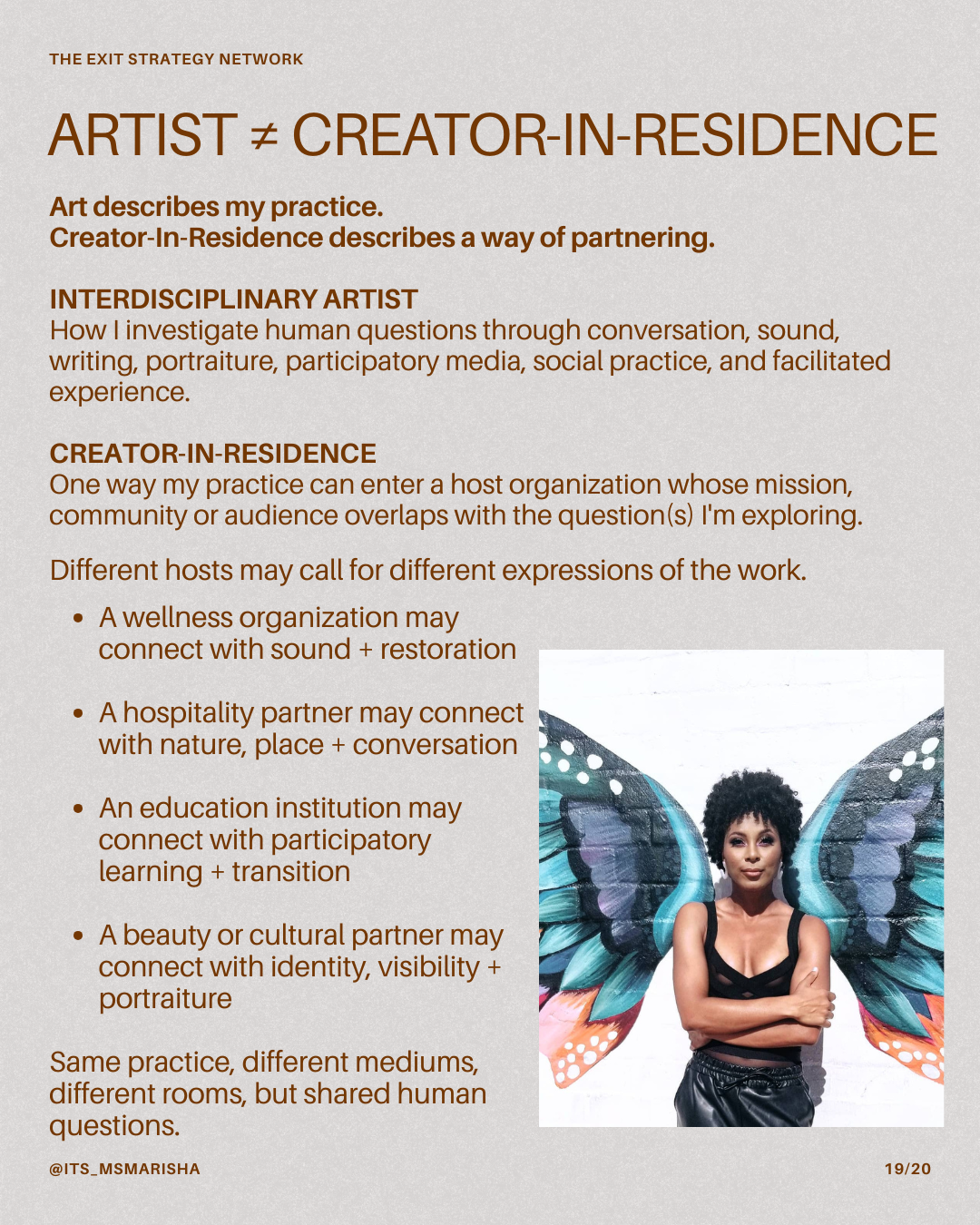
The work was always there.
I thought my transition was asking me to decide what I wanted to become next. Increasingly, I realize it was asking me to recognize what had already existed the entire time that I didn’t fully nurture.
The questions were always there. The methods were always there. The work was always there.nWhat changed was my willingness to author the container.
I simply needed enough distance to stop confusing the institution with the contribution and because I have, I'm now building the ecosystem.
Hi, I’m Ms. Marisha. I’m an educator turned Creator-in-Residence, storyteller, and founder of The Exit Strategy Network.
I partner with brands, schools, cities, communities, and institutions ready to move beyond content and build regenerative culture through storytelling, enrichment, experience design, and community-centered strategy.
Explore my background
Read more on Creator-in-Residence
Watch my news clip
Let’s connect on a discovery call

The Life I Lost When I Chose Myself: Grieving the Woman Everyone Loved and Learning to Live as The One I Am
It all begins with an idea.

I didn’t know you could grieve a life you were still living.
No one tells you that when you stop abandoning yourself, parts of your old world will die, sometimes loudly, sometimes in the quiet way of unanswered texts and a calendar that doesn’t look like it used to. There’s no funeral for the you who was always “fine.” No black dress for the woman who finally drops the cape.
We don’t have much language for that kind of loss. So I made my own.
I call it abandoning self-abandonment, when you stop leaving yourself to stay chosen, to stay safe, to stay employed, to stay loved. It’s an act of honoring the parts of you that have been whispering, “Please don’t forget me.”
What I didn’t expect was the grief that would follow.
The Death of the Version of Me Everyone Loved
For most of my adult life, my value was measured in how well I disappeared.
I was the one who stayed late, picked up the extra work, listened to everyone’s crisis at 1 a.m., and still showed up polished, pleasant, productive. I knew how to perform “strong Black woman” so well I could have taught a masterclass.
On paper, I had the life I’d worked hard for: degrees, leadership roles, the “you’re so inspiring” DMs, the calendar full of meetings that proved how needed I was. If you took a screenshot, it would have looked like success.
But my body kept the receipts.
The tension that lived in my shoulders. The insomnia that smiled politely in Zoom meetings. The numbness that showed up in moments that were supposed to feel like joy. The quiet panic of realizing I didn’t know what I actually wanted, I only knew what I was good at surviving.
When I finally started listening to my own no’s, the first thing that died was the idea of myself I’d spent years curating.
And nobody warns you that choosing yourself can look, from the outside, like you’re ruining your life.
Meeting the Versions of Me I’d Left Behind
To survive, I had split myself into pieces without realizing it. Eventually, I personified and gave those parts of me names so I could stop pretending they didn’t exist.
Khalia: the quiet, sensual one, raised on religious shame and “good girl” rules, who learned early that her body and desire was dangerous.
Hunter: the athlete, the grinder, the one who knew how to outrun pain by outworking everyone in the room.
Nik: the teacher, the caretaker, the one who believed her worth lived in how many people she could help, even if she was falling apart.
Mari: the artist, the intuitive, the one who saw beauty and magic everywhere, but kept being told to “be realistic.”
For years, these parts of me worked for free carrying my trauma, shouldering my expectations, performing my way into rooms that didn’t know what to do with the fullness of me.
When I started my “Year of Kintsugi,” I didn’t realize I was signing up to intentionally disrupt my life and break up with an outdated version of myself.
I just knew I couldn’t keep pretending the cracks weren’t there.
Kintsugi, the Japanese art form intended to repair broken pottery using lacquer mixed with powdered gold. The damage and rejoining reflects the history of the object. The gold is intended to highlight the journey of the object and not disguise the broken pieces. This became the metaphor that held me. The idea that the brokenness is not the shame, it’s the story. That the mending can be both visible and beautiful.
But you have to admit something is broken before you ever touch the gold.
Identity Grief: Mourning the Self You Were Never Allowed to Be
There’s the grief that comes when you lose something you love. And then there’s the grief that comes when you realize you lost yourself while everyone was celebrating you.
I started saying no.
No to the projects that paid well but drained me.
No to being the crisis hotline loved one who never got to fall apart.
No to dating dynamics where I became therapist, mother, and emotional sponge, all in one.
Sometimes it feels isolating. Other times…powerful.
People who were used to my constant ‘yes’ didn’t know what to do with my boundaries. Some quietly stepped back. Some got angry. Some called me selfish. A few dear ones stayed and adjusted, but its been a long stretch where “choosing myself” has looked like long walks alone and a bank account that reflected the cost of leaving misaligned work.
That’s the part we rarely post or talk about.
We celebrate the glow-up, the rebrand, the “soft life.” But we don’t always discuss the prerequisites of the soft life: grief, confusion, and the very real terror and overwhelm of building a new self while the old one is still being requested.
I remember one night, sitting on my childhood bed, realizing I had spent decades being the “good one,” the “safe one,” the “responsible one” and I was exhausted. I had spent so much time being a home for everyone else that I had no idea where I lived.
The grief hit me like a breakup.
Not with a person but with a version of me I’d outgrown.
The Body Remembers What the Mind Tries to Negotiate
Grief is not just thoughts. It’s tissue, heartbeat, breath.
As I started to abandon self-abandonment, my body began reacting like someone had pulled the fire alarm.
The old scripts like “be grateful,” “don’t rock the boat,” “you’re too much,” “you’re too sensitive” didn’t just vanish because I changed my language. They lived in my muscles, in the way my shoulders tried to rise up and apologize for taking up space.
I started to notice how my body reacted when I was about to betray myself:
The tightness in my throat right before I said “Sure, no problem” when every fiber of me wanted to say, “Actually, I can’t.”
The sinking feeling in my gut when I ignored a red flag in work, in love, in my own health because I didn’t want to be “dramatic.”
The quiet ache after another night of scrolling, disconnected from my own desires, numbing instead of nurturing.
The body remembers.
That’s part of why I began building a meditation project I now call Free Spirit, not as a pretty wellness accessory, but as a survival tool. A way to score my own healing in real time. Sound became the bridge back to myself when words felt thick and clumsy.
Because the grief of self-abandonment doesn’t only live in memory, it lives in the nervous system, and healing lives there too.
Healing as a Series of Small, Disobedient Acts
Healing, for me, hasn’t been one big cinematic moment. It’s been a series of small rebellions against the life I built on over-functioning.
Lighting a candle and taking a shower like it was a ceremony, not a chore.
Listening to my own voice on a guided track and letting it hold me the way I had held everyone else.
Saying, “I actually need help,” and letting the silence after that sentence exist.
It’s been Khalia choosing pleasure without asking for permission from old doctrine.
Hunter putting the cape down and letting sweat be about joy, not punishment.
Nik letting her worth exist even when she’s not teaching, mentoring, fixing something or someone.
Mari making art that doesn’t have to justify itself with a grant proposal or social media validation.
And somewhere beyond them, Halo becomes the integrated self. She’s learning to walk into rooms confidently whole, without leaving parts of herself at the door to make others comfortable.
That wholeness still costs me things. Sometimes it costs me invitations. Sometimes it costs me the illusion of being easy to love.
But the more I practice, the more I see: every act of self-honoring ripples. When I model rest, other women exhale. When I tell the truth about my grief, how much I miss the version of me that could handle anything because she didn’t feel anything, someone else realizes they’re not weak for wanting out.
What We Talk About When We Talk About Loss
When we typically discuss loss, grief, and healing, our first thought is of funerals, diagnoses, heartbreak.
But lately, I think of the day I looked at my life and realized: I made this entire world while half of me was missing.
I grieved for the girl who swallowed her questions in church.
The woman who let jobs call her “family” while they quietly drained her spirit.
The version of me who knew how to shrink strategically to survive.
I still love her. I also had to let her go.
But there is a different kind of life on the other side of that grief.
One where your body is not an afterthought.
Where your “NO” is not a betrayal but a boundary.
Where your pleasure, your rest, your curiosity are not rewards for suffering they’re part of your daily ritual.
I am still very much in process. I have not mastered this. Some days, I still catch myself reaching for the cape, rehearsing the old lines: I’ve got it, no worries, I’m fine.
But more and more, I choose differently.
I put a hand on my chest.
I listen to my own breath.
And I say, out loud if I have to:
“I refuse to abandon myself for a life that can’t hold all of me.”
That sentence has cost me old versions of success, timelines I thought I’d be on by now, and the comfort of being easily understood.
It’s also giving me something I didn’t know how to grieve because I’d never really had it:
A life I don’t have to leave myself to live.
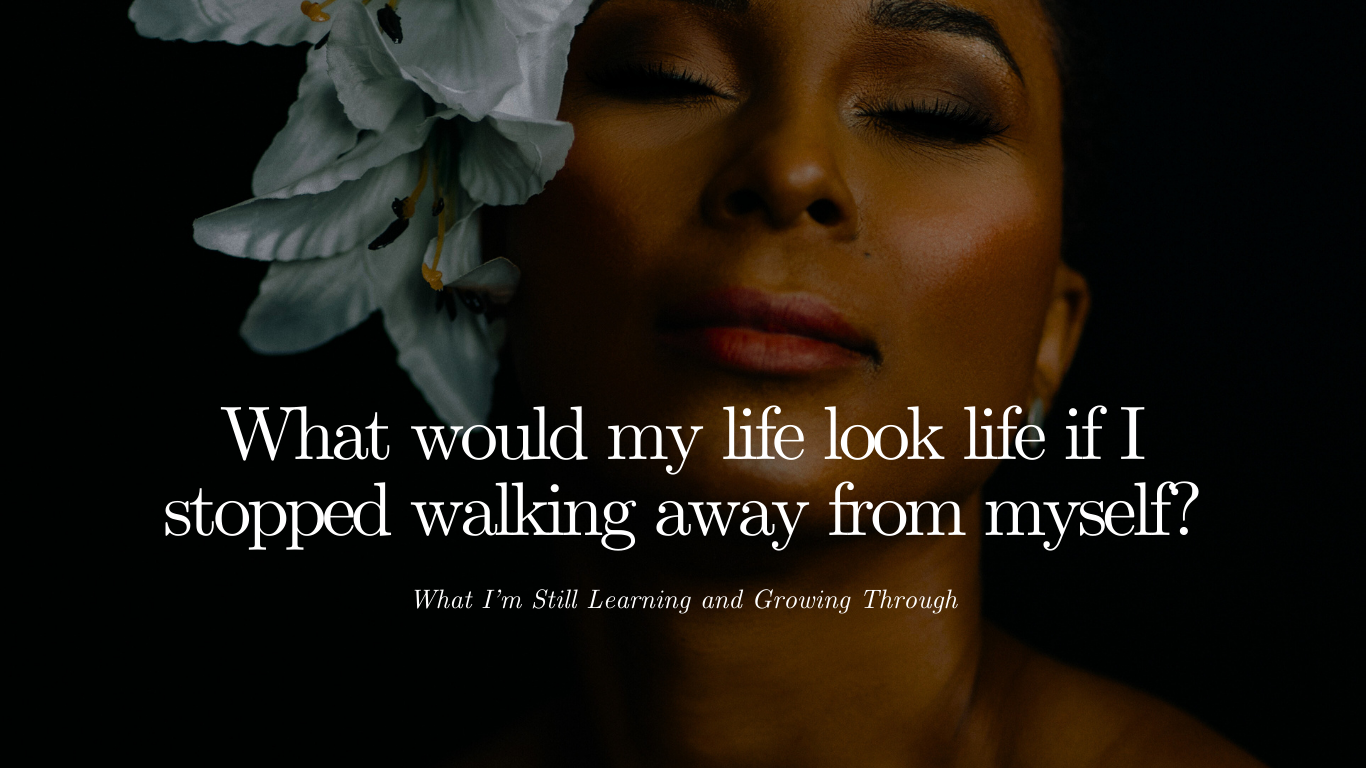
I Used to Call It Hustle, My Body Called It Harm: 30 Sacred Yeses That Taught Me the Difference
There’s a particular kind of fatigue that doesn’t show up on lab work or your Oura ring.
You can sleep eight hours, drink the green juice, hit inbox zero and still feel like you’re melting at the edges of your own life.
For my twenties and most of my thirties, that was me.
On paper, I was thriving: educator, matchmaker, coach, author, strategist, “strong friend,” the one who always had language (and time) for everyone else’s breakdowns and breakthroughs.
But privately, I was fluent in something I didn’t yet have words for:
Self-abandonment.

There’s a particular kind of fatigue that doesn’t show up on lab work or your Oura ring.
You can sleep eight hours, drink the green juice, hit inbox zero and still feel like you’re melting at the edges of your own life.
For my twenties and most of my thirties, that was me.
On paper, I was thriving: educator, matchmaker, coach, author, strategist, “strong friend,” the one who always had language (and time) for everyone else’s breakdowns and breakthroughs.
But privately, I was fluent in something I didn’t yet have words for:
Self-abandonment.
Not the glamorous kind that comes with a dramatic exit and a new haircut. The quiet kind. The “I’ll just…” kind.
I’ll just take on one more project.
I’ll just swallow that comment.
I’ll just ignore what my body’s been whispering for months.
It shows up in emails you answer at 11:47 PM, in dates you say yes to when your spirit is screaming no, in jobs you stay in because you’re afraid of what happens when you stop performing.
I built a life around being useful to everyone but myself.
It took years, a recession, a pandemic, a nervous system revolting, a few relationships ending, a couple of career pivots, and four alter-egos (The 4 Personas) that surfaced during a year-long mental health sabbatical to finally admit:
I had mastered the art of curating a life that looked intentional while quietly erasing the woman at the center of it.
2025 was the year I decided to stop calling that “normal” and start calling it what it was: a pattern, one I could study, interrupt, and re-design.
I have finally landed on a name this inner work: Abandoning Self-Abandonment™ and this piece, this list of 30 Sacred Yeses, is my first public record of what it actually looks like in practice.
It’s part memoir, part field guide, and maybe the most honest thing I’ve written about what it means to create, to connect, and to build a life without burning yourself down to keep the lights on.
What I Mean by Self-Abandonment
Self-abandonment is not just “bad boundaries.”
It’s the slow, habitual leaving of yourself.
It’s when your calendar reflects everyone else’s priorities but yours.
When you apologize for your needs before you even say them out loud.
When your work is dazzling but your body feels like a hostile workplace.
It’s the teacher who never stops teaching, even when no one is listening.
The “nice” partner who never asks for reciprocity.
The leader who leads everyone but themselves.
For me, it looked like:
Over-performing at work while under-feeling in my own life.
Saying yes to roles that exploited my care…and no to creative risks that could have freed me.
Treating my body like a vehicle for productivity instead of a home.
On the outside, it reads as achievement.
On the inside, it feels like vanishing.
The Shift from Autopilot to Agency
I didn’t fix this with a vision board and a bubble bath.
I started with one brutal, liberating truth:
I am not just overworked. I am under-honored…by me.
This past year, there was no dramatic makeover montage. No overnight rebrand. Just a woman in her 40s standing in front of a bathroom mirror, asking herself a question that refused to let her go:
“What would my life look like if I stopped walking away from myself?”
Not metaphorically. Not in a hashtag.
Literally stopped leaving my body, my needs, my voice, my desires behind to be palatable, productive, or praise-worthy.
I didn’t start with a framework. I started with a feeling: I’m tired of being applauded for the parts of me that are slowly killing me.
What I’m Still Learning and Growing Through
To abandon self-abandonment is not to become selfish or detached. It’s to recognize that you cannot build a regenerative ecosystem including a family, a brand, a classroom, a community, or a company on the unpaid labor of your own erasure.
It means:
You don’t teach your nervous system that love equals disappearing.
You don’t teach your clients that your boundaries are optional.
You don’t teach your audience that your worth hinges on how “on” you are.
You don’t teach your collaborators that urgency and chaos are your default.
You become, instead, a living case study in another way of being.
Your yes becomes sacred when it costs you self-respect to say no.
Your no becomes sacred when it costs you approval to say yes.
So I began tracing:
Where did I first learn to ignore my own signals?
How did religion, respectability, and “strong woman” culture teach me that my exhaustion was proof of my goodness?
How many of my “yeses” were actually fear wearing a cute outfit?
That inquiry eventually birthed a whole ecosystem I’m beginning to nurture. It was as if I curated my life like an exhibit titled:
Here Lies a Woman Who Refused to Leave Herself Behind.
The artifacts became:
Abandoning Self-Abandonment™ the framework and language.
Free Spirit a meditation album about returning home to self.
Ease as a Regenerative Practice experiments in living without self-erasure.
Where I Left Myself a long-form video series on the micro-betrayals and micro-repairs that shape a life.
Receipts & Red Flags field notes on modern love and self-respect.
Regenerative Case Files story-driven breakdowns of brands and systems trying (or failing) to move beyond extraction.
All of it, every series, every project, every offering is, at its core, another Sacred Yes. All of them orbit one question:
What happens when a woman stops outsourcing her worth to institutions, relationships, or productivity and starts treating self-honoring as a daily practice, not a prize?
My answer began, not with a grand gesture, but with 30 small, sacred yeses.
30 Sacred Yeses: A Different Kind of List
Sacred Yeses are not resolutions.
They are reorientations.
They don’t ask, “How can I become better at abandoning myself more beautifully?” They ask, “What would change if I stayed?”
Stayed honest.
Stayed inside my body.
Stayed with my intuition long enough to hear what it’s been trying to say.
These are not resolutions.
They’re receipts.
They’re tiny, disruptive choices I made this year to stop leaving myself behind. I’ve grouped them loosely by arena: body, work, love, voice, money, and possibility.
Use them as mirrors, not mandates.
Yes to My Body
1. Yes to listening before it screams.
I stopped waiting for breakdowns and burnout and started paying attention to the early whispers from my body: eye aches, brain fog, exhaustion, irritability. Instead of muscling through, I asked, “What are you trying to protect me from?”
2. Yes to gut health as gospel, not trend.
I stopped treating my stomach like a trash can for convenience food and started relating to it as a second brain. Tests, tweaks, and tenderness, not punishment, became my approach.
3. Yes to movement that feels like power, not penance.
Boxing, walks in my childhood neighborhood, listening to LoFi or binaural frequency playlists while stretching to open my heart and hips in my living room on Sunday mornings when everyone else was at church. Less “burn 500 calories,” more “can I feel myself breathing again?”
4. Yes to perimenopause honesty.
Instead of whispering about hormone changes like a scandal, I started saying it plainly: my body is shifting, and I deserve support. Sweats, bloating, and mood swings don’t make me weak, they make me human.
5. Yes to sleep as strategy.
I stopped glamorizing 2AM productivity and started romanticizing being in bed at a decent time, unless I genuinely had the inspiration and energy. My creativity sharpened the moment I stopped treating rest like a side hustle.
Yes to Work that Doesn’t Require Disappearing
6. Yes to leaving titles that no longer fit.
“Educator,” “coach,” “consultant” were accurate but incomplete. I said yes to holding the more honest titles: wellness journalist, creator-in-residence, regenerative ecosystem designer.
7. Yes to turning my frameworks into art.
Abandoning Self-Abandonment™ stopped living in my notes app and has become inspiration for talks, meditations, and series. I stopped hoarding brilliance in Google Docs, my second brain.
8. Yes to working with, not for, brands.
Instead of chasing gigs that drained me, I began designing creator-in-residence models where I show up as a peer, not a prop. No more partnerships that require me to dim my values or point of view as a 40+ woman.
9. Yes to fewer, deeper commitments.
I walked away from “a little bit of everything” and chose a smaller set of aligned projects: Free Spirit, Ease as a Regenerative Practice, and my thought leadership on future-of-education.
10. Yes to ease as a KPI.
If an opportunity promised money but cost me my sanity, I let it go. Ease became a measure of success, not a reward I get at the end.
Yes to Love That Doesn’t Feed on Self-Doubt
11. Yes to walking away when my nervous system said no.
There were men who looked good on paper but felt bad in my body. I stopped explaining away my discomfort and started honoring it.
12. Yes to calling it a red flag, not a “quirk.”
Passive aggression, emotional unavailability, unresolved trauma that bred lack of self-awareness or trust in others, control disguised as protection. I stopped romanticizing what my spirit knew was misalignment.
13. Yes to being desired and respected.
I stopped negotiating between chemistry and care. The bar is now “emotionally intelligent, spiritually grounded, financially responsible, prioritizes health, and deeply kind” or we’re not a match.
14. Yes to Receipts & Red Flags.
I turned my dating adventures and matchmaking history into a public lab. Not to drag anyone, but to normalize women choosing self-respect over romantic scarcity.
15. Yes to being loved where I actually live.
I stopped presenting a polished persona and started letting people meet the parts of me that are tender, complicated, and still in process.
Yes to My Own Voice
16. Yes to recording before I feel “ready.”
From ‘Refined Garden’ to ‘Where I Left Myself.’ I stopped waiting for the perfect outline and started recording the truth of where I was.
17. Yes to experimenting in public.
Some episodes are polished, while others feel like voice notes to my future self. I post anyway. The point is not perfection; it’s presence.
18. Yes to sound as medicine.
Free Spirit meditation album, sonic essays like Please, BARE With Me are examples of how my voice became more than a tool for teaching. It’s now a home I was rebuilding for myself.
19. Yes to saying the quiet parts out loud.
The ways religion shaped my shame. The cost of always being “the strong one.” The grief of losing an old identity. If it was haunting my body, it belonged in my work.
20. Yes to narrating from the middle, not the mountaintop.
I’m in the place between no longer and not yet, so I’m not sharing to say “I have arrived,” but “I am arriving.” That framing alone dissolves so much pressure.
Yes to Money that Matches My Mission
21. Yes to minimums that honor my labor.
I set a baseline $10K/month and started making decisions like a woman who expects her work to be resourced, not “thanked.”
22. Yes to naming my value clearly.
Instead of vague “services,” I now speak about creator-in-residence programs, frameworks, and IP that host brands can plug into and co-develop.
23. Yes to walking away from misaligned money.
If a partnership meant confused deliverables, diluting my message, tokenizing my story, or glamorizing burnout, the answer became no even when the number was tempting.
24. Yes to building my own distribution channels.
Website and newsletter under construction, YouTube for raw sonic work, contributing to social platforms and conversations that are intentionally meaningful. My goal is not virality, it’s sovereignty.
25. Yes to money as a reflection of alignment, not martyrdom.
I stopped chasing income that required me to sacrifice my health. Revenue and regeneration have to sit at the same table now.
Yes to a Future that Includes Me
26. Yes to being a student of my own life.
Instead of just designing curriculum and frameworks for others, I became my own case study. Ease, pleasure, discipline, grief. I let it all teach me.
27. Yes to leaving old scripts on read.
The “strong Black woman,” the “good girl,” the “successful professional,” I stopped auditioning for roles I didn’t write.
28. Yes to building regenerative ecosystems, not just personal brands.
Every project or initiative now is a node in a larger vision where people, institutions, and communities stop running on depletion.
29. Yes to giving myself the love I’ve tried to earn from work.
I am slowly learning to see myself as more than my output. To treat my body, my ideas, my heart like they’re already enough.
30. Yes to being here. Fully.
This might be the most sacred yes of all: I am staying with myself. In confusion, in clarity, in desire, in doubt. I am no longer leaving me.
Why I’m Writing This Now
I could have waited until everything was polished, perfectly packaged, ready for a big reveal. But that would have been another quiet act of self-abandonment, another moment where I made being “finished” more important than being honest.
So I’m sharing this now, while it’s still tender.
While I’m still revising.
While my life still looks like a draft in places.
Because maybe you’re here, too:
Half in a role that no longer fits, but afraid of what leaving might cost.
Half in relationships that require you to mute parts of yourself or your truth.
Half in your body, half hovering just above it, trying not to feel so much.
Half invested in that creative idea or business venture because you haven’t yet strengthened the muscle that requires you to be confident and fully trust your process, your value, the vision planted inside you, even when everything around you is screaming it will flop.
What This Means for 2026 (and for you)
If any part of you recognized yourself in these yeses, in the quiet self-betrayals, in the ache for something more honest, then this isn’t just my story. It’s our case study, and your invitation. The invite is not to fix it all by tomorrow, but to choose one Sacred Yes.
One place where you will not walk away from yourself this time.
In 2026, I’ll be going deeper into this work through:
Where I Left Myself: long-form video reflections on the micro-betrayals and micro-repairs that shape a life.
Receipts & Red Flags: Field Notes on Modern Love: carousel series on love, dating, and self-respect as a 40-something “rich auntie” who refuses to abandon herself to be chosen.
Regenerative Case Files: story-driven breakdowns of brands and systems experimenting with less extraction, more regeneration.
Free Spirit: a guided meditation album about coming home to your own inner compass.
Abandoning Self-Abandonment™ talks, workshops, and creator-in-residence experiences for people and institutions ready to rethink how we live, learn, lead, and love.
If you want companions on this path, here’s where you can follow my journey:
Read this full piece and future essays on my site.
Subscribe and Watch Where I Left Myself and Refined Garden on YouTube.
Join the dialogue follow on IG, TikTok, Threads, and LinkedIn where I’ll be sharing more Sacred Yeses, red flags & receipts, and regenerative experiments in real time.
Your Turn: Gentle Assignment
Before you close this tab, here’s a simple starting place:
Name one pattern of self-abandonment you’re ready to retire. Overexplaining? Overworking? Over-pleasing? Silencing desire?
Name one Sacred Yes that speaks to it. A boundary. A ritual. A conversation. A decision.
Practice it once. Not perfectly. Just honestly. Let your nervous system know: we are doing this differently now.
Connect with a sacred yes you can make this week that moves you one step away from self-abandonment and one step closer to self-honoring. Start there. The revolution within has to begin somewhere.

The Season of Self: From Holiday Obligation to Intentional Celebration
For many of us, “the most wonderful time of the year” arrives heavy with expectation and obligation. We inherit unspoken scripts about how the holidays should be, which gatherings to attend, how to behave, even what happiness is supposed to look like. We play roles written for us in childhood: the peacemaker smoothing conflicts, the tireless host ensuring everyone else is comfortable, the achiever striving to make everything perfect. These roles aren’t accidents, they’re survival strategies adopted over years to keep the peace. And yet, wearing these familiar costumes often means losing pieces of ourselves in the process.

The car idles in your parents’ driveway, warm light spilling from the windows and shadows of laughter dancing on the curtains. You grip the steering wheel, heart quickening. Inside, family awaits with decades of traditions and expectations. Inside, you’re the good son, the agreeable daughter, the one who never rocks the boat. But out here, in the quiet of your car, a small voice asks: “What about what I need this holiday?” In that pause, caught between the pull of obligation and the longing for authenticity, you face a choice: continue the familiar script of self-abandonment, or dare to honor yourself and step into the holidays with intention.
The Weight of Holiday Obligations
For many of us, “the most wonderful time of the year” arrives heavy with expectation and obligation. We inherit unspoken scripts about how the holidays should be, which gatherings to attend, how to behave, even what happiness is supposed to look like. We play roles written for us in childhood: the peacemaker smoothing conflicts, the tireless host ensuring everyone else is comfortable, the achiever striving to make everything perfect. These roles aren’t accidents, they’re survival strategies adopted over years to keep the peace. And yet, wearing these familiar costumes often means losing pieces of ourselves in the process.
It’s no surprise that “holiday obligation” can breed quiet turmoil. Nearly nine in ten adults say they feel stressed by things like money pressures, missing loved ones, or anticipating family conflict during this season and 79% admit that they become so focused on creating special moments for others that they overlook their own needs. We say “yes” to every invite, bake the pies from scratch, buy just the right gifts, all the while ignoring the inner voice whispering that we’re exhausted, or hurting, or yearning for a different way. The holidays, meant for joy and connection, instead start to feel like an emotional endurance test run on autopilot. We find ourselves counting down the days not with excitement, but with anxiety and a hope that we can simply get through it without falling apart.
The Cost of Self-Abandonment
When you consistently abandon yourself to meet external expectations, the toll runs deep. Resentment often simmers beneath the surface cheer. You might recognize that pang when you’ve stretched yourself too thin, agreeing to buy items out of your budget, host the big family dinner (again), or travel to three different houses in one day to please everyone. Each time we override our own needs or values to fulfill a sense of duty, we chip away at our peace. Overextended and running on fumes, it’s common to feel anxious, irritable, or utterly drained while everyone else seems to be enjoying the festivities. In private, you may wonder why you feel so unlike the “happy” version of yourself you try to portray.
Beyond the emotional strain, self-abandonment can impact our physical and mental wellness. Chronic holiday stress, specifically the kind that comes from constantly people-pleasing and “keeping the peace,” can lead to fatigue, weakened immunity, and lingering blues long after the decorations are put away. In one survey, a majority of Americans (51%) said it takes them weeks to decompress and feel less stressed after the holidays. Think about that: by the time we recover, we’re often already well into the new year, carrying the baggage of last year’s burnout. When our inner well is empty, moments that should be meaningful may barely register. We’re physically present at the party, but our spirit is far away, lost in the haze of obligation. This is the quiet heartbreak of self-abandonment: being surrounded by loved ones yet feeling invisible, because we have made ourselves invisible.

Shifting from Obligation to Intention
What would it look like to flip the script, to approach the holidays from intention rather than obligation? It starts with one brave, pivotal question:
“Am I choosing this, or am I reacting out of guilt or habit?”
Pause and ask yourself this whenever the familiar pull of “I have to do this” creeps in. That small moment of reflection creates space for a more grounded response.
Shifting to intention doesn’t mean abandoning your family or ditching tradition entirely. It means participating by choice, not by default. It means letting go of the black-and-white thinking that you either please everyone or please yourself, in reality, there is a liberating gray area in between. In this gray space, you can honor both connection and rest without losing yourself in obligation. For example, you might decide to attend the annual gathering but drive separately so you can leave when you need to. You might choose one beloved tradition (baking cookies with your nieces, perhaps) to fully engage in, and gently skip another that no longer feels authentic. You can offer support to your family without assuming responsibility for everyone’s emotions.
Each intentional choice is like a breath of fresh air in a stuffy room. At first, others may not understand the change, especially if you’ve long been the one who always complies. That’s okay. When pressed, calmly express that you’re trying something new this year to make the holidays more meaningful and sustainable. Authenticity can be contagious, your shift may even give loved ones permission to share their own needs and limits. By choosing intention over obligation, you transform the holiday experience from a performance into an actual celebration, one where you have a say in what celebration means to you.

Practicing Self-Honoring (Actionable Ideas)
Embracing self-honoring over self-abandonment is a practice, one that grows easier with preparation and courage. Here are a few gentle, actionable ways to start rewriting your holiday script in alignment with your wellbeing and values:
Start with Self-Reflection: Before the holiday bustle hits full swing, carve out a quiet moment to check in with yourself. Journal or meditate on what you truly want from this season. Is it rest? Spiritual renewal? Deeper one-on-one connections instead of big parties? Get clear on your intentions so you can anchor your decisions in them.
Set One Loving Boundary: Identify one situation where you often feel stretched too thin or uneasy during the holidays. Practice setting a compassionate boundary around that scenario. It could sound like, “I’d love to come by for Thanksgiving, but I will be heading home around 8 PM to recharge.” This statement affirms your love for family and your responsibility to your own wellbeing. Remember, a boundary is an act of love, not a rejection.
Reimagine a Tradition: Give yourself permission to update or let go of traditions that no longer resonate. If hosting the big dinner causes more anxiety than joy, maybe propose a potluck or a rotating host system. If endless gift exchanges feel expensive or impersonal, suggest drawing names, setting a price limit, or donating to charities in each other’s names. Replace “we do this because we always have” with rituals that feel sincere and light you up.
Plan Micro-Exits and Micro-Resets: Support yourself with small strategies to stay centered. Drive your own car to gatherings so you can leave when energy runs low, or take a brief walk between dinner and dessert to breathe and regroup. Even stepping into the bathroom for a few slow breaths, or noticing the sensation of your feet on the ground, can help reset a frazzled nervous system. These tiny breaks ensure you remain present and regulated, instead of running on reflex and fumes.
Lean on a Support System: Self-honoring doesn’t mean doing everything alone. Confide in an ally which may be a sibling, partner, or friend. Tell them about your intention to approach the holidays differently. Having someone in your corner, even silently, can reinforce your resolve when guilt or old habits start tugging at you. If tensions arise, a quick knowing glance or encouraging text from your ally can remind you that you’re choosing a healthy path, and you’re not alone in it.
Above all, speak to yourself with kindness throughout this process. It’s easy to fall into self-criticism if others push back or if you stumble into old patterns (“Ugh, I promised myself I wouldn’t get sucked into that drama…” etc.). Instead, celebrate every small step you take toward honoring your needs. Each “no” that protects your peace, each honest conversation, each tradition tweaked in a healthier direction are all victories. They are evidence that you are showing up for yourself, not just for everyone else.

Self-Honoring as a Regenerative Gift
Deep down, choosing self-honoring over self-abandonment isn’t selfish, it’s regenerative. Think of your energy and emotional wellbeing as a garden. When you constantly give and perform out of obligation, without tending to your own soil, that garden withers. But when you honor yourself, when you rest, say no, ask for help, or follow what feels genuinely meaningful, you are watering your roots. You’re replenishing the very source from which your love and presence flow. Over time, this practice yields a lush garden of authenticity, resilience, and even more to give others from a full heart.
Importantly, self-honoring can rewrite inherited stories in real time. Perhaps you come from a culture or family where sacrifice is equated with love. You can respect that history and evolve it. By gently stepping out of the old role you were assigned, you model a new way forward, one where love is not measured by how much of yourself you can sacrifice. The truth is, when you take care of yourself, you’re not betraying anyone. You are stepping out of roles that no longer serve you and creating space for relationships that are more honest and alive. Over time, those around you may come to appreciate the more relaxed, genuine YOU that shines when you’re no longer acting from duty alone.
As the snow falls or the lights twinkle this year, imagine writing your own holiday story, one intentional choice at a time. You might find that presence means more than presents, and that a peaceful cup of cocoa by the fire (because you chose to leave the party early) can be just as sacred as any loud tradition. In honoring yourself, you give your loved ones the gift of a happier, healthier you and you give yourself the gift of belonging in your own life. After all, the season’s true spirit isn’t found in exhausting ourselves to meet expectations, it’s discovered in those moments where we are fully here, heart and mind, true to who we are.
Call to Action: This holiday season, dare to put you on your gift list. What is one intention you will set to honor your needs and joy? Take a moment to reflect, maybe write it down or share it with a loved one. And as you venture into this intentional holiday, remember that every time you choose self-honoring over self-abandonment, you’re contributing to a more regenerative, authentic way of life for you and everyone around you. You deserve to thrive this season and beyond, give yourself that permission, and watch the magic unfold.
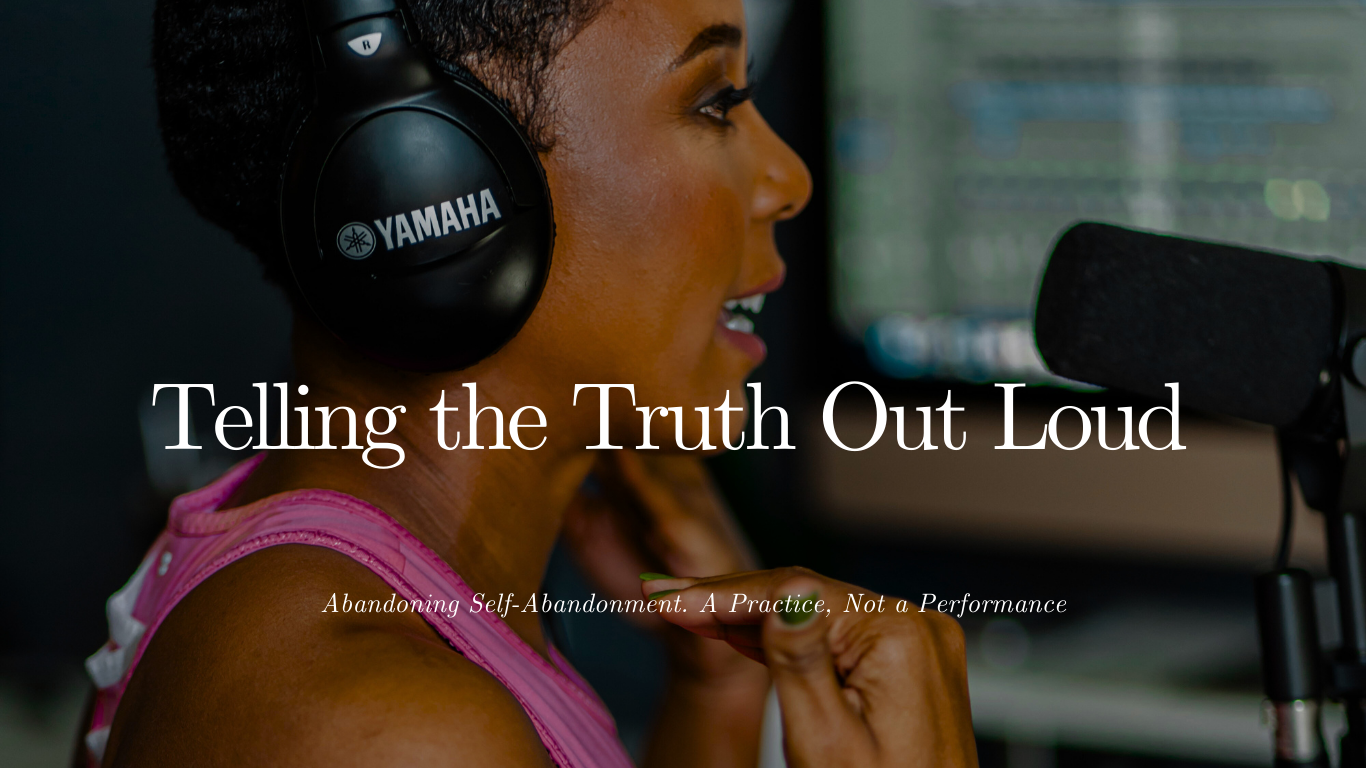
Abandoning Self-Abandonment: When Your Own Voice Becomes Home Again
For years, my voice was fluent in what the world needed from me.
I knew how to encourage a classroom.
How to soothe a team.
How to be the calm one, the wise one, the “you always know what to say” one.
I did not know how to say:
“I’m tired.”
“I’m not okay.”
“This isn’t working for me.”
“I don’t want this life I built in someone else’s language.”
Self-abandonment doesn’t begin as a dramatic betrayal.
It begins as a slight edit.
There’s a particular sound your own voice makes when it remembers you.
Not the voice you use in meetings, not the one polished for panels or interviews, not even the one you slip into when people say, “You’re such a natural storyteller.”
I’m talking about the voice that comes out when you’re walking alone in your childhood neighborhood, or sitting in your parked car too long after an appointment, or whispering into your phone at 2:17 a.m. because if you don’t say this out loud, you’re afraid you might forget yourself again.
That’s the voice I’ve been chasing.
And, slowly, reclaiming.

The Sound of Self-Abandonment
For years, my voice was fluent in what the world needed from me.
I knew how to encourage a classroom. How to soothe a team. How to be the calm one, the wise one, the “you always know what to say” one.
I did not know how to say:
“I’m tired.”
“I’m not okay.”
“This isn’t working for me.”
“I don’t want this life I built in someone else’s language.”
Self-abandonment doesn’t begin as a dramatic betrayal.
It begins as a slight edit.
You soften your “no” into “maybe.” You trade an honest answer for the polite one. You choose the version of yourself that keeps the room comfortable, even if your body is begging you to leave.
Over time, that edit becomes a script. The script becomes a role. And the role becomes your entire personality.
Until one day you wake up and realize you have built an impressive life that does not feel like a home.

Why Sound? Why Now?
When I launched my sonic experiences, it wasn’t just a creative experiment.
It was an act of spiritual triage.
I was exhausted by screens and performance.
I was tired of autopiloting my way through healing, sharing perfect posts, polished language, aesthetically pleasing breakdowns.
I needed fewer visuals and more presence.
Less curation and more communion.
So I stripped everything down to voice.
No music. No fancy edits.
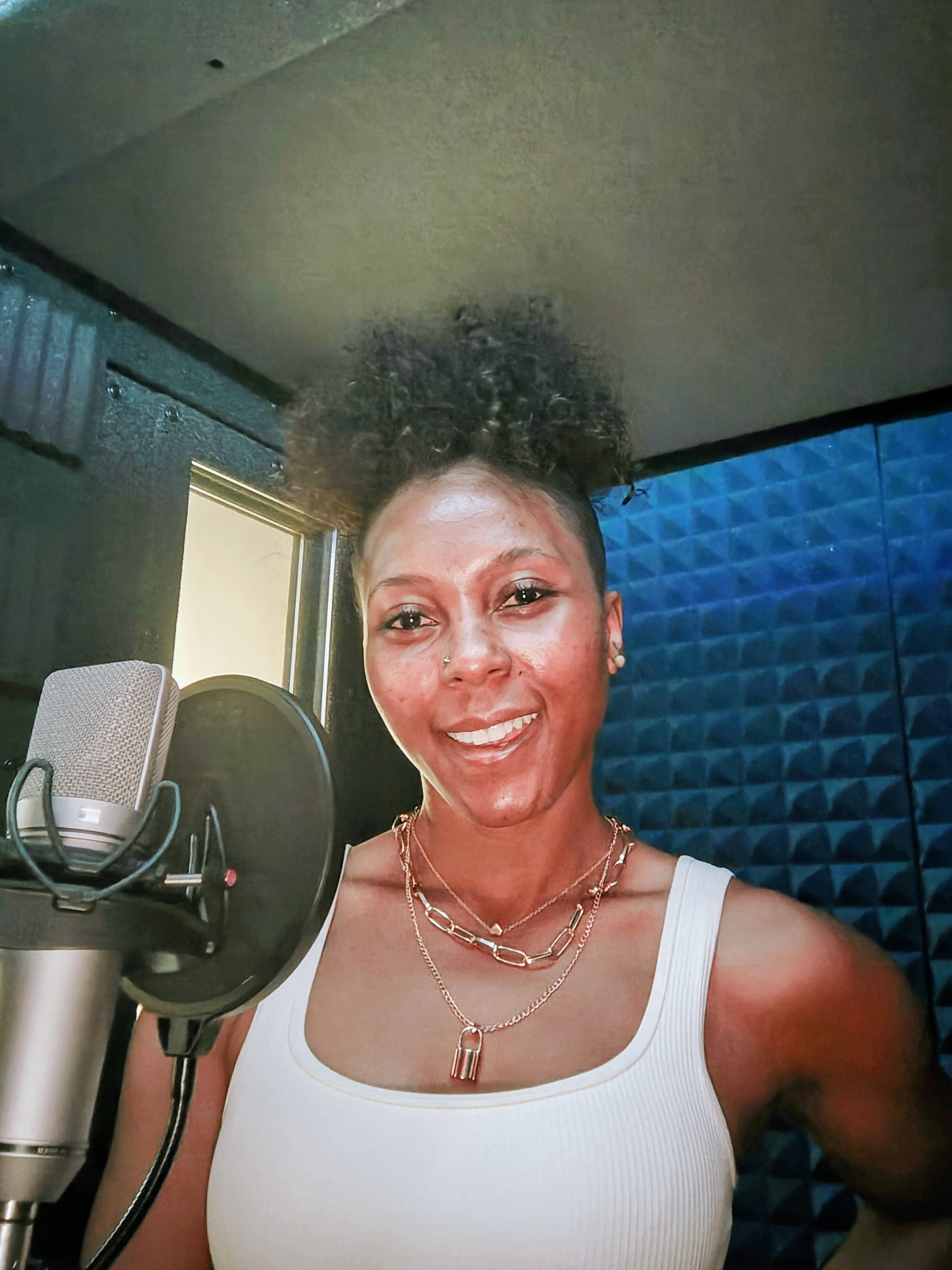
Just me, a mic, and the truth of where I actually was.
Those early recordings were shaky and raw.
Some of them will never leave my private folder.
But they taught me something I couldn’t learn anywhere else:
My nervous system trusts my voice before it trusts anyone else’s praise.
When I hear myself tell the truth out loud, something in my body unclenches.
The performance drops.
The teacher, strategist, curator, fixer all step aside and the human being steps forward.
That’s the part of me I am committed to not losing again.
The Four Acts: How My Voice Walked Me Home
Recently, I recorded a four-part audio series that traces the inner journey I’ve been on:
Act I: Conditioning
This was all about the early training: be agreeable, be grateful, be excellent, be small. My voice learned to carry other people’s expectations better than it carried my own needs.Act II: Collapse
This was the quiet breakdown. My life looked “together” on the outside, but my inner world was held together with frayed threads and unspoken grief.Act III: Confrontation
Here, I finally faced the questions I could no longer swallow: Who profits from my self-doubt? Who benefits from my over-functioning? Why does my body feel like a battlefield when I’ve done everything “right”?Act IV: Communion
And finally, this was my decision to stop outsourcing my wholeness. To treat my own voice as a place to meet myself, not manage myself. To let my body, my desire, my boundaries, my curiosity have a say in how my life is designed.
Those four acts are not a hero’s journey.
They’re a circular path.
I still loop through all four, but now I move through them with more awareness, more language, and more compassion.
Abandoning Self-Abandonment: A Practice, Not a Performance
“Abandoning self-abandonment” sounds poetic. But in practice, it’s not glamorous.
It looks like:
Pausing before you say “yes” and checking if your body really means it.
Recording a voice note to yourself after a hard conversation and listening back for where you disappeared.
Saying, “I need a moment,” instead of bulldozing your own feelings to keep the peace.
Letting your art, your writing, your sound be honest before it’s impressive.
For me, it also looks like designing a life and body of work that doesn’t require me to erase myself in order to be effective.
I’m not interested in helping people “optimize” their lives inside systems that demand their erasure. I’m interested in asking:
What becomes possible when we stop leaving ourselves?

Why Your Voice Matters to the Collective
This is bigger than individual healing.
When we normalize self-abandonment, we build families, workplaces, schools, and spiritual communities that rely on people overriding themselves to keep everything running.
We call martyrdom “good leadership.”
We call burnout “dedication.”
We call emotional numbness “maturity.”
But a world built on people abandoning themselves cannot sustain collective wellbeing.
The opposite is also true:
Every time one person chooses self-honoring over self-erasure, the ecosystem shifts a little.
Boundaries modeled in one household become blueprints for healthier friendships and partnerships.
A leader who refuses to glamorize burnout creates space for humane work culture.
A creator who tells the truth instead of selling a fantasy gives permission for others to live, not just perform, their lives.
That’s why I’m starting this new season of my work with my own voice.
If I can’t hear myself clearly, I have no business telling the world how to transform.
An Invitation to Listen Differently
So here’s my invitation to you:
Sometime this week, take 3–5 minutes to record yourself talking.
No script. No performance.
Just you, talking to yourself about where you really are.
You don’t have to post it.
You don’t have to transcribe it.
Just share, and listen to your own voice.
Notice where your voice gets small, where it rushes, where it gets bright, where it trembles but refuses to lie.
Ask yourself:
Where have I been leaving myself?
What truth have I been rehearsing silently that I’m finally ready to say out loud?
If I stopped abandoning myself, what would need to change, even in small, almost invisible ways in how I live, learn, love, and lead?
My work, from here forward, is a loud and gentle yes to those questions.
The truth is: I’m not just designing frameworks about regeneration and self-honoring. I’m living them, in public, in progress.
This four-act audio series is the first offering in that commitment. It’s my way of saying I am done disappearing into versions of myself that make everyone comfortable but leave me hollow.
I’m reclaiming the sound of my own life.
I hope, in some small way, it helps you reclaim yours too.

The Invitation
If you feel called, I’d love to hear from you. In the comments or your journal, complete this sentence:
“My voice has been carrying ______, but I want it to start carrying ______.”
Or, if that feels too vulnerable right now, just save this piece and come back when you’re ready. Either way, may you hear yourself more clearly than the noise of who you were told to be.

The Creator-in-Residence: How Brands, Cities, and Schools Can Build Regenerative Culture Not Just Content
Unlike one-off influencer deals, a Creator-In-Residence embeds with a partner host (i.e. brand, educational institution, museum, foundation, hospitality group, etc.) to co-design activations, resources, or programming that serves real people in real time.
Think: a living lab of content + community + curriculum.

What if creation sounded like healing? What if a brand campaign felt like a breath released? What if a school could graduate not only skilled workers but whole humans?
The Creator-in-Residence (CIR) is more than a title. I believe it’s a model blueprint for shifting from extraction to regeneration inside companies, campuses, cultural institutions, and communities. It’s where Creator-Educators are central to elevating humanity, where story becomes ceremony, voice becomes infrastructure, and content matures into culture.
Why Now?
The Problem: Ecosystems in Decline
Every world, whether natural, human, or institutional, thrives when it operates in balance. A beehive depends on nectar, a family relies on care, a city flourishes through trust, and a workplace grows when its people feel valued. In their natural state, all ecosystems are interdependent, resilient, and abundant.
But when extraction becomes the dominant mode of operating, when resources are drained without replenishment, ecosystems weaken. Malnourished hives collapse, communities fragment, organizations burn out, and entire societies spiral into disconnection. Our current systems, particularly in the Western context are designed to reinforce this extraction. They prioritize profit over people, control over creativity, and disease over wellbeing.
The result is predictable: imbalance, inequity, and the deterioration of the very inhabitants these systems should sustain.
We are witnessing this decline in our classrooms, where outdated methods fail to nourish educators and their learners. In our communities, where disconnection erodes empathy, vulnerability, belonging, safety. In our industries, talent is exploited rather than cultivated. And in our culture, where scarcity narratives overshadow possibilities for abundance.
The problem is clear: we are operating in extractive systems that do not serve humanity’s collective flourishing.
The Solution: Championing Creativity to Build Regenerative Worlds
But close your eyes. Take a moment. Breathe.
Imagine if you traveled wherever you desired, but your journey wasn’t just about where you went, it was about how you returned home: restored, wiser, and more connected.
That’s what regeneration means to me, shifting from extraction to reciprocity and from consuming culture to co-creating with it. In nature, regeneration restores balance, in humanity, it restores meaning, and in business, it’s becoming the blueprint for long-term value. This is why we must prioritize platforms and invest in programming that champions collaboration and creativity, as now more than ever, it’s imperative to build regenerative systems in our homes, communities, schools, and workplaces.
The Architects of Impact: How Creator-Educators Are Changing the Game
My skills intersect education, cross-cultural collaboration, storytelling, and social impact strategy. From the classroom to the creator economy, my experience along with my commitment to nurturing spaces that deepen connection, creativity and commerce are not just relevant, they’re essential to building regenerative worlds for all of us. This combination of dedication, expertise and versatility is what will give rise to our time’s most invaluable disruptors, Creator-Educators. Unlike influencers, Creator-Educators aren’t measured by likes. They’re measured by impact: their ability to unlock curiosity, courage, and capability.

I see Creator-Educators as perfect partners to document the future of the creator economy and that future is one where content doesn’t just entertain but enlightens, and where the stories we share become the new playbooks for how humanity might live, learn, lead and love.
Creator-Educators don’t exist to simply capture content. We move beyond the edge of one-off posts. As modern visionaries, innovative entrepreneurs, the new media moguls, and social impact thinkers, Creator-Educators aim to co-design consistent and carefully curated multi-sensory, multidisciplinary programming that can show the world what regenerative possibilities looks like. We design and amplify content-driven experiences, spaces, resources, and opportunities that replenish people, cultures, and the planet.
That’s the lens I bring to new partners who recognize we’re sitting at a pivotal moment in history. A moment in time where it is our collective responsibility to consider Creator-In-Residence initiatives so we can teach storytelling, practice experience design, and use cross-cultural exploration to highlight why now is the ideal time to prioritize building regenerative worlds, and experiment with how we begin to take action in real time.
Three Forces Have Converged:
The creator economy is no longer a side hustle, it’s strategy. Major retailers and platforms are institutionalizing creator partnerships: Lowe’s launched a full Creator Network with MrBeast and a dedicated storefront, tying creators directly to commerce and product experiences. (Lowe’s Corporate)
Gen Z is choosing creation as a career path. Morning Consult reports 57% of Gen Z would become influencers if given the chance, and trust in creators has risen notably since 2019. Universities are responding with new curricula and programs focused on the creator economy. (Morning Consult Pro)
Institutions are formalizing residencies to shape innovation and culture. From YouTube’s product-shaping Creator-in-Residence cohorts to Solange’s three-year Scholar-in-Residence appointment at USC, residencies are moving from “artist perks” to strategic engines of R&D, audience engagement, and cultural leadership. (blog.youtube)
The signal is clear: Creator-Educators aren’t just promoting stories, they’re leveraging Creator-In-Residence partnerships and building regenerative systems and programming that audiences trust, return to, and buy from.

What a Creator-in-Residence (CIR) Actually Does
Unlike one-off influencer deals, a Creator-In-Residence embeds with a partner host (i.e. brand, educational institution, museum, foundation, hospitality group, etc.) to co-design activations, resources, or programming that serves real people in real time.
Think: a living lab of content + community + curriculum.
For Mindful Mornings: I curate and narrate meditations and offer micro-rituals that restore the nervous system.
For Somatic Storytelling: I craft reverse-confessional narratives and reflection tools for emotional processing.
For Erotic Imagination: I compose shame-free, guided sensual practices as a pathway to self-acceptance and relational health.
For Voicework: I create second-person audio narratives that deepen listening, vulnerability, and leadership presence.
Across a 3–12 month residency, these and other series become a curriculum, customized to the host’s goals. The beauty of my CIR model is that it’s not only a professional offering but a deeply personal artifact, something that is authored by someone living the work rather than simply designing programs for others.
In other words, I’m not just teaching regeneration, I’m modeling it. I am inviting potential host brands and institutions to co-create with me as a peer in exploration, not simply a consultant selling a framework.

Solange announcing her latest partnership with USC on October 13, 2025. The singer wore Fendi and Sophie Buhai jewelry.
Why the CIR Model Beats the One-And-Done Campaign
From Marketing to Meaning: Creators-In-Residence help brands tell braver, truer stories, consistently. Long-form partnerships outperform “viral-hope” buys and align with the industry shift toward deeper creator integrations. (Forbes)
From Audience to Community: Residencies create rituals from weekly lives, meditations, diaries and more. Creator-Educators and their CIR programming keeps people coming back, on and off platform. They also generate first-party insights that inform product, UX, service design and more. YouTube’s CIR has done this for years. (blog.youtube)
From Optics to Outcomes: CIRs can be tied to wellbeing KPIs (i.e. retention, sentiment lift, stress-reduction feedback), educational KPIs (i.e. reflection completion, leadership scores), and revenue KPIs (i.e. subscriptions, merch, ticketing, co-branded drops).
From Content Cost Center to Cultural R&D: Residencies open space for pilots whether that’s creator studios inside retail like Walmart’s creator studio movement, or my Auralism x Khalia sonic branding and live-to-commerce experiences that blend ritual, story, and shopping. (LinkedIn)
Pioneering Signals to Watch (and Cite When You Pitch)
Solange × USC three-year Scholar-in-Residence highlights artistry can be embedded in academia as cultural research and community building. (Billboard)
Lowe’s Creator Network where creators are tied to storefronts and signature events (Beast Games) to platform their expertise, authenticity, and relatability as architects of impact, not just media buys. (Lowe’s Corporate)
YouTube CIR highlights creators shaping product, policy, and inclusion through ongoing cohorts including an LGBTQ+ residence focused on real feature change. (blog.youtube)
Higher Ed’s Response more colleges are formalizing creator-career courses as Gen Z’s “dream job” becomes mainstream curriculum. (Forbes)
The Regenerative Case: What Brands, Cities, and Schools Gain
Brand Value
Durable Trust: creators as internal culture carriers, not external contractors.
Owned IP: episodic audio/video series, rituals, and events that compound. *
Measurable Lift: engagement quality, sentiment, retention, and conversion.
Education Value
Emotional Literacy at Scale: learning through listening and reflection.
Career Relevance: creator economy skills with ethics and wellbeing.
Cross-Discipline Labs: media, psychology, design, and leadership in one space.
Community Value
Access to restorative experiences (often free or sliding scale).
Safe, shame-free spaces around intimacy, grief, identity, and pleasure.
Economic mobility: paid apprenticeships, fellowships, and creator studios.
Workforce Value
Millennials and their Gen Z cousins want independence and are building it
94% (Gen Z) aim for financial independence and turn to entrepreneurial creator paths
CIR programs help employers meet them where they live: purpose-led, skill-stacked, and self-authored. (Business Insider).
The Invitation
If you’re ready to move beyond campaigns and into communion, to create work that feels as good as it performs, consider a Creator-in-Residence.
Embed humanity. Design rituals. Measure regeneration.
I’m enrolling a small number of hosts for three, six, nine, and 12-month residencies across wellness, beauty, hospitality, education, media, culture, and Corporate Social Responsibility.
Let’s create a season of regeneration your audience will hear, feel, remember and return to.

The Treasure Chest & the Side Character: The Practice of Reversing Identity Grief
But here’s the truth: a chest that looks full on the outside can still feel hollow inside.
That’s the quiet ache of identity grief, realizing the life you’ve built doesn’t feel like yours.
Identity grief is sneaky.
It doesn’t scream.
It whispers through mornings when you wake up with dread instead of excitement.

I’ve been exploring how to move from default living to intentional design.
I decided to reflect on what I’ve been learning after coming across the photo above.
I recently found that pic of myself at 18. I remember being bright-eyed, curious, unafraid of possibility. Somewhere between that girl and the woman I became, my life began to fill with “treasures” that weren’t mine.
Titles.
Timelines.
Roles.
Expectations.

At first, the chest looked impressive. Full, polished, respectable. But here’s the truth: A chest that looks full on the outside can still feel hollow inside.
That’s the quiet ache of identity grief, realizing the life you’ve built doesn’t feel like yours. Identity grief is sneaky. It doesn’t scream.

It whispers through mornings when you wake up with dread instead of excitement.
It seeps in when you feel like a side character in your own story, going through the motions, checking off boxes, playing a role you never auditioned for.
It shows up in the gap between what society applauds and what your soul actually desires.
On paper, you’re “on track.” But in your spirit, you’re lost. That’s when the chest feels heavy. That’s when the auto-pilot becomes unbearable. Default living doesn’t just drain us, it disconnects us.
It disconnects us from others because our relationships are built on roles and performances, not truth.
A life on autopilot disconnects us from ourselves because every compromise chips away at authenticity.
And that disconnection has a cost: anxiety, exhaustion, resentment, and the slow erosion of joy.
I know because that was my reality for longer than I care to admit.

But I’ve been sitting with that.
The grief.
And what I’ve learned?
Grief in this form is an invitation. A call to open the chest and take inventory. To stop living on auto-pilot and step into authorship.

Prompts that made me curious that I’m challenging you to ask yourself:
What in my life feels inherited, not chosen?
Where am I performing instead of being my full self?
What treasures do I actually want to keep, polish, and protect?
What do I need to release so there’s room for what’s real?
The process and the answers may feel uncomfortable.
But discomfort is the birthplace of alignment.

Identity grief is the wake-up call, a mirror.
It reminds us that our story isn’t over, but ready to be rewritten.
You get to choose again.
I decided to choose again.
And in choosing, you don’t just rebuild a life, you reintroduce yourself to the world as the author of your story, carrying a treasure chest filled not with timelines and “shoulds,” but with pleasure, full being, and purpose.
The grief of default living is real, but so is the freedom of design.
Your chest can be full again.
This time with treasures that reflect the soul you carry.