
The Work Was Always There, The Environment Wasn’t: What Stepping Outside Institutions Taught Me About Building a More Self-Authored Way to Contribute
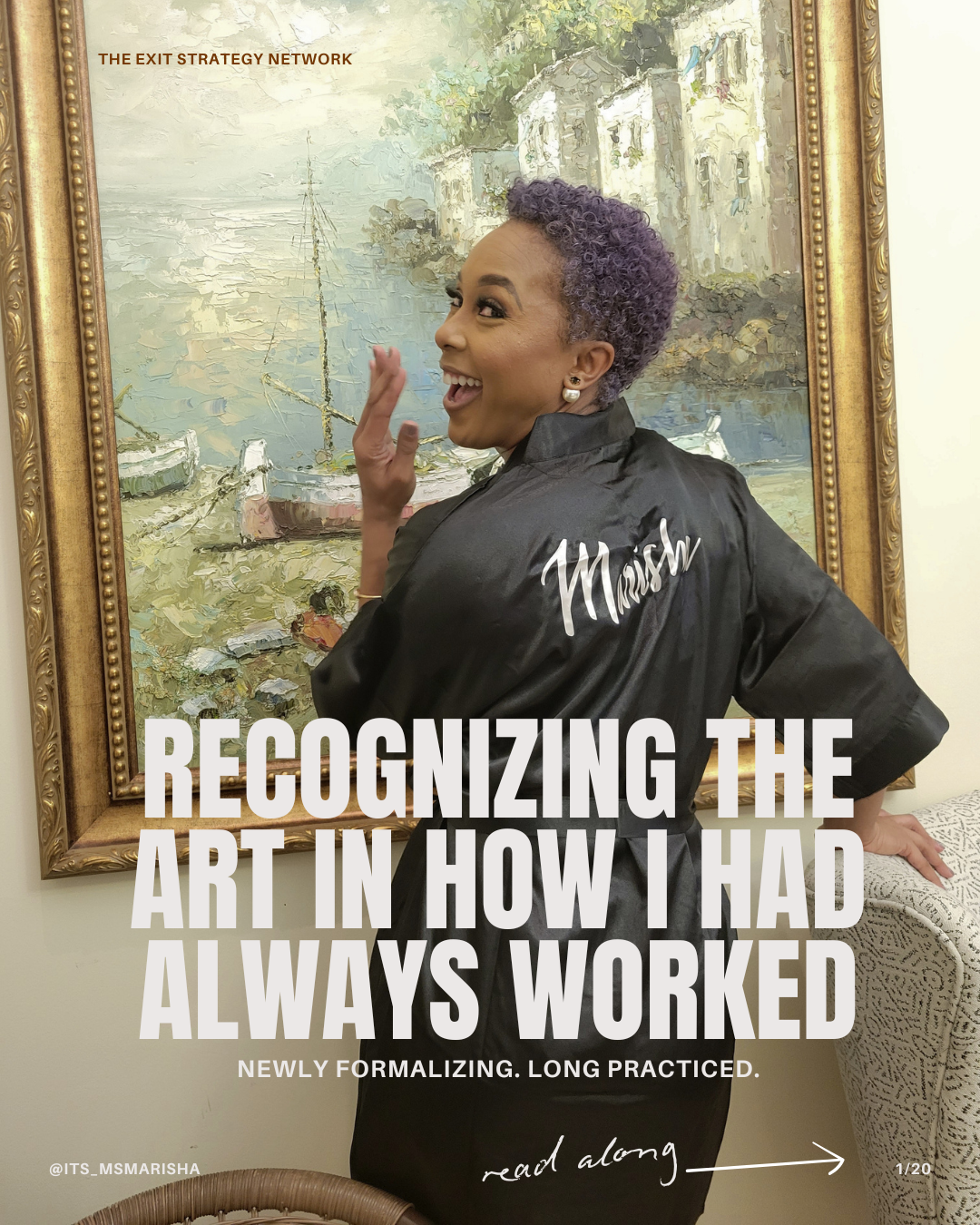
I used to think a coherent career was one that moved predictably from title to title. Mine didn't. What I couldn't see while I was busy working inside extractive systems was that professional continuity can live somewhere other than a resume.
It can live in the questions you keep asking, the functions you keep performing, the problems you keep noticing, the ways people repeatedly come to you for help, and the creative methods you reach for even when nobody has assigned them to you.
My career has become much more coherent now that I’ve stopped organizing it by title and started organizing it by throughline.
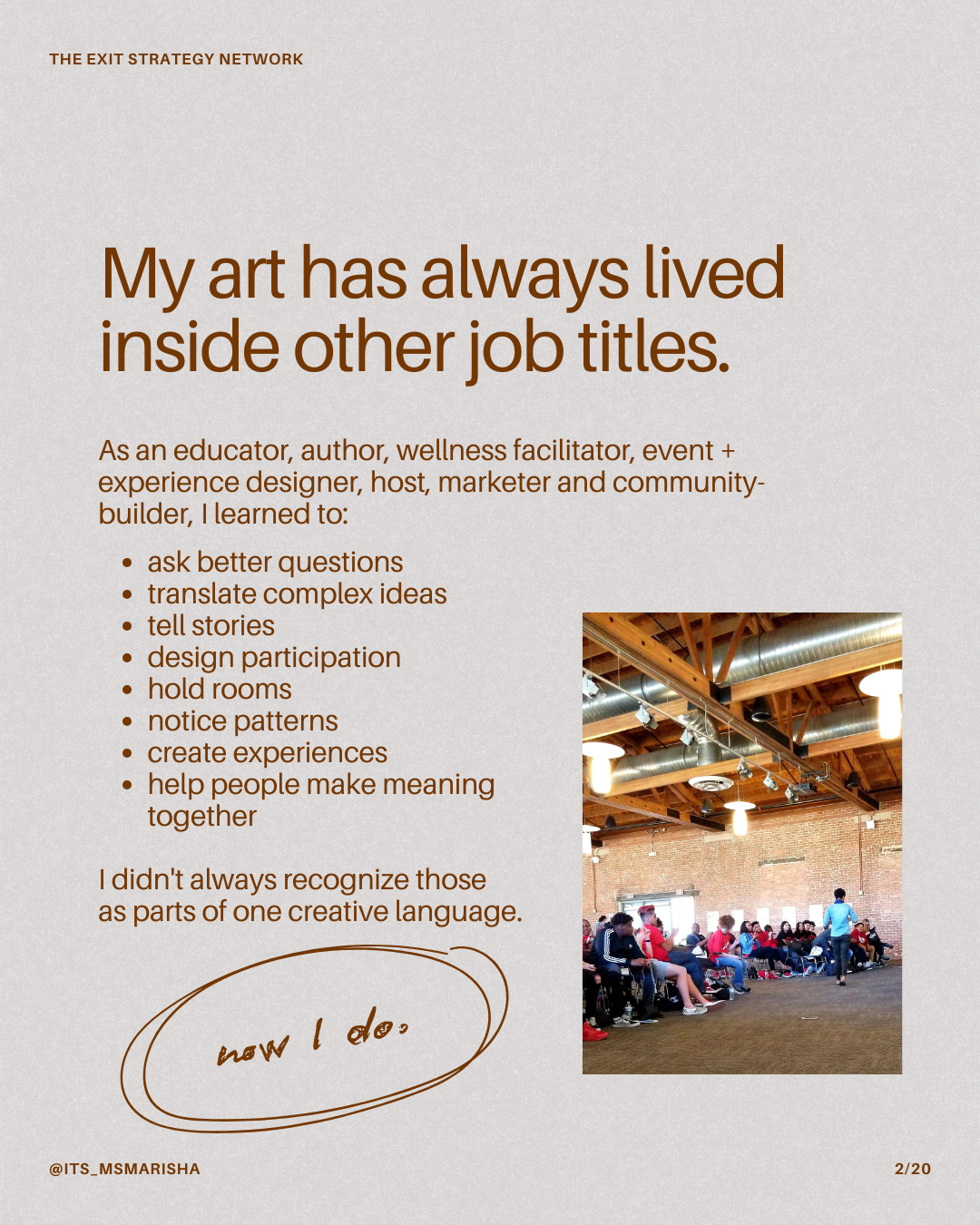
There’s a strange thing that happens when you spend enough years becoming good at your job. Eventually, the title can become so effective at describing where you work that it starts obscuring what you actually know how to do. I was a teacher. Then I wasn't. I worked in:
Nonprofit program consulting and strategic partnerships
Afterschool program development
Interviewing
Marketing and recruiting
Event and video production
Admissions and outreach
Matchmaking, coaching, and content creation
Wellness advising, program development, and facilitation
Higher education
Social enterprise development and project management
Community-building.
Creative direction
Writing.
For years, I understood those as different chapters of my resume. It took leaving the institutions and freelance world that housed much of that work for me to recognize that I had been asking similar questions and performing similar functions almost everywhere I went.
That realization has changed the way I think about career transition.
Sometimes Distance is Data
I used to think stepping away from my professional life meant I was losing momentum.
What I gained was perspective.
When there was no department telling me my responsibilities, no job description determining which skills were relevant and no institution organizing my time and compensation around its priorities, I had to ask a different question:
What do I keep doing when no one is assigning it to me?
I notice patterns, listen for contradictions, and I become curious about what people can't quite name. I look at what a system says it provides and what the humans inside it are actually experiencing. In almost every role, I translate complicated ideas, connect disciplines that don't always talk to one another, and then I start imagining what could fill the gap.
That showed up when I taught, when I interviewed people, in matchmaking, in boardrooms where I facilitated wellness programs and it showed up in media, events, my book and community experiences.
The subject changed, but the function didn't.
That’s an important distinction for anyone navigating a professional transition because a career can look nonlinear when organized by title and incredibly coherent when organized by function.
Job titles are containers, not the totality of our value.
This matters particularly for people whose work has been relational, educational, cultural or service-oriented.
Teachers often know how to facilitate, translate, observe, design experiences, communicate across differences, manage a room, understand audience needs and turn complexity into something usable
Social workers understand systems, behavior, story, community, crisis and human motivation
Health professionals carry enormous amounts of knowledge about mind/body, how to cultivate trust, behavior change and lived human experience
Community organizers understand participation
Nonprofit leaders understand mobilization
Researchers understand inquiry
None of those abilities disappear because someone leaves the institution where they first practiced them, but most of us were never taught to separate the function from the container. We were taught to look for the next title.
I'm becoming more interested in another question:
What else can what you know become?
This is why the Creator Economy interests me
If you’ve been following my recent content on social media, you’ll notice I’ve been discussing creator degrees being formalized at universities, multidisciplinary artists securing residencies, and other creator economy related topics. But this isn’t because I believe the future of work is everyone dancing into a ring light.
The interesting part to me is permission and infrastructure.
We are watching institutions experiment with forms of contribution that don't fit as neatly inside conventional professional categories.
USC named Solange its first Scholar-in-Residence at Thornton, with a three-year role that includes curricular and programmatic development around her multidisciplinary expertise. (USC Thornton School of Music)
UCLA has built artist-in-residence work with Keke Palmer that connects her creative practice, ownership philosophy, mentorship and KeyTV distribution ecosystem to students. (Creative Intelligence is the New Essential)
Starbucks went outside the conventional marketing-team structure and hired full-time Global Coffee Creators whose job is to immerse themselves in coffee, culture, community and place and tell the brand's stories from inside that experience. Starbucks itself has described the program as evidence of the evolving role creators play in brand storytelling, not simply another content initiative. (About Starbucks)
A Create-it Studios pilot inside a Walmart Supercenter in Franklin, Tennessee has added podcasting, recording, video, live-production and workshop infrastructure to a physical retail environment. A place designed primarily to sell goods can now also function as a place where people learn and make things. (My LinkedIn post)
And we've watched social-first creators like Reesa Teesa demonstrate that a story initially shared directly with an audience can become the proof for something more durable: publishing, intellectual property and a business life beyond the original platform.
I don't think these examples represent one new profession. I think they represent a much larger question:
What happens when organizations stop assuming valuable knowledge only enters through traditional employment structures?
The Creator-in-Residence model is my answer to part of that question.
A Creator-in-Residence is interesting to me because it provides a bridge between two sets of assets that are usually separated:
The individual carries experience, perspective, expertise, creative intelligence, cultural fluency and a relationship to a question.
The organization carries resources, infrastructure, community, distribution, place, credibility and capital.
Neither side necessarily needs to become the other.
The artist doesn't need to become the marketing department. The educator doesn't have to become an employee. The organization doesn't have to build an entirely new internal function. Instead they can ask:
Where does what this person knows intersect with something our community genuinely needs?
That intersection might result in media, but it might just as easily result in a workshop, an installation, a listening experience, curriculum, a story archive, a community conversation, a guided practice, a research inquiry, a live event, a residency, a resource people continue using after a campaign would normally be over.
That is why I keep saying that Creator-in-Residence is not another name for content creator. Content may be evidence of the work, it may distribute the work, it may even help people discover the work, but the actual product is deeper: human insight translated into public value.
A residency gives an organization access to a practice not merely a deliverable.
I'm building this as a business model, not a side project.
That distinction matters to me personally because like many impact professionals, I have spent years being useful inside other people's structures.
I know how easy it is to respond to transition by frantically collecting freelance projects, consulting assignments and side hustles until you've quietly rebuilt another exhausting version of the life you were trying to exit.
I don't want that. I’m building something more intentional.
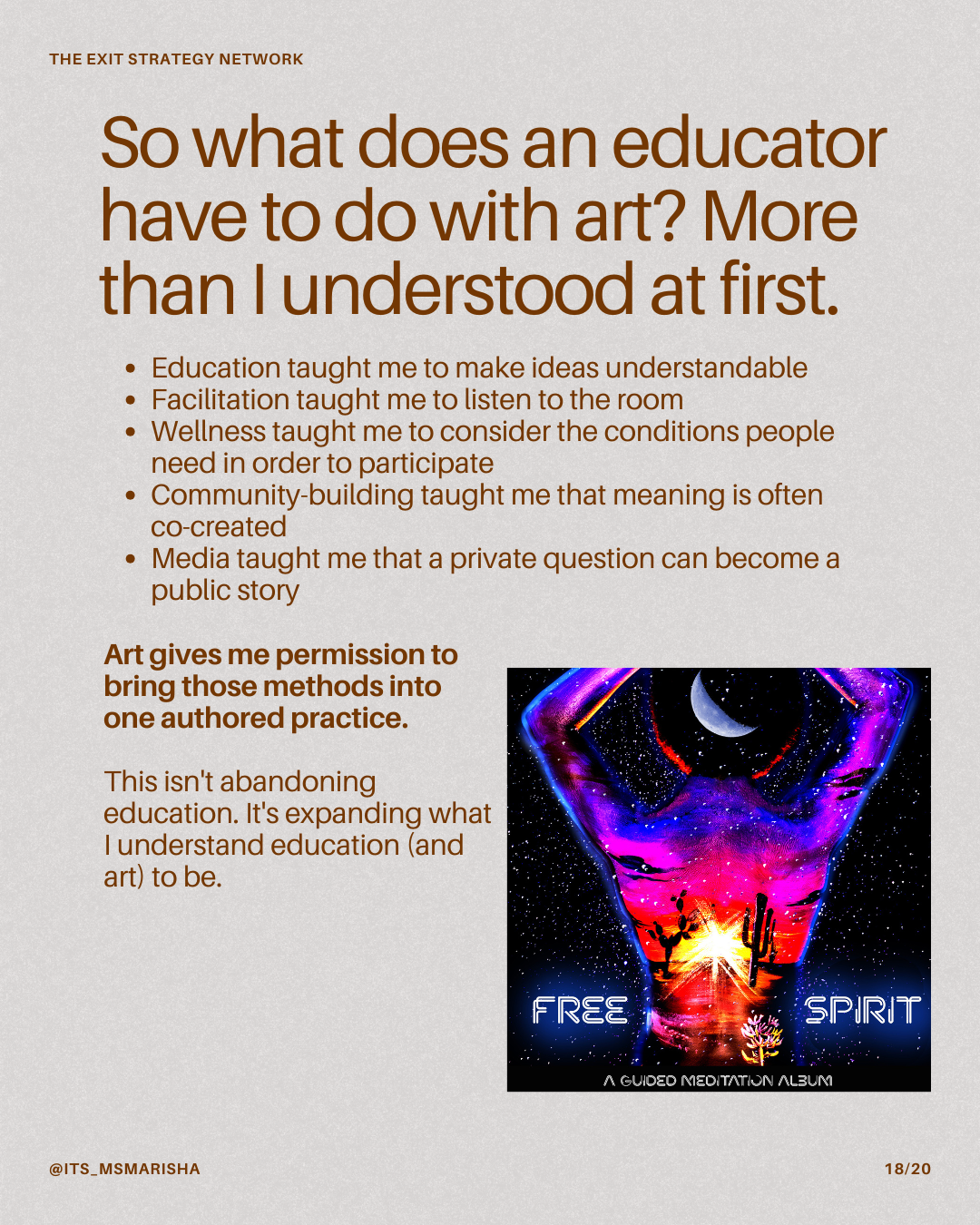
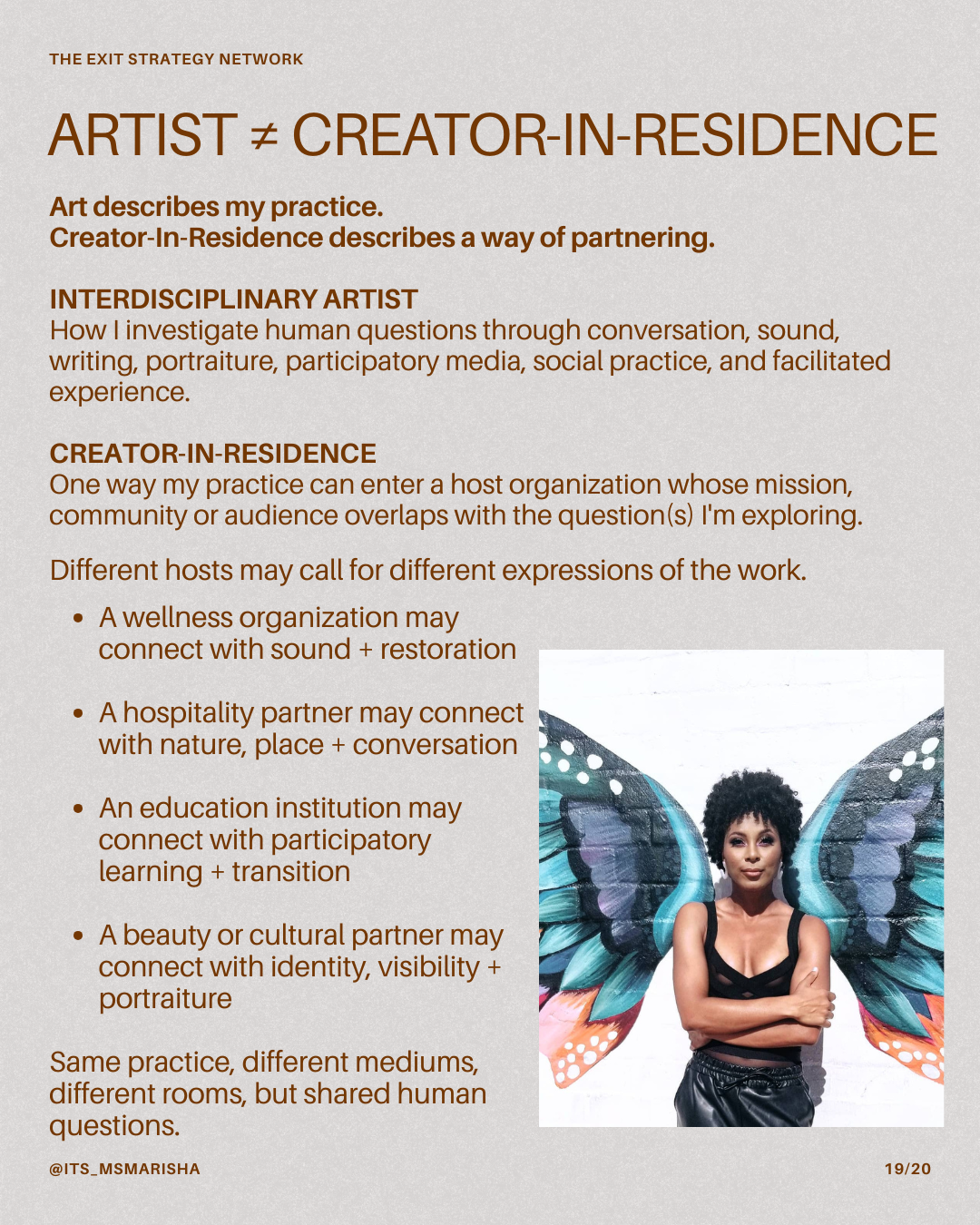
My interdisciplinary artistic practice gives me a way to organize the questions and mediums I’m personally exploring.
Creator-in-Residence gives me one economic and partnership model through which that practice can enter aligned organizations.
The Exit Strategy Network gives me the larger ecosystem to explore the sustainability of all this and I’m Case Study #001.
The point is not to prove that everyone should follow my exact path, but instead learn:
what the pathway requires,
what needs to be named,
what needs to be packaged,
what is intellectual property,
what belongs to the creator
what does a host organization receive
how should public value be measured
what makes the relationship regenerative instead of extractive
what infrastructure makes the work financially sustainable, and
how do we help someone recognize what they already know before telling them what product to create from it?
Those are both business and workforce questions. And increasingly, I think they’re education questions.

For impact professionals, your exit may be an act of reorganization.
The more intentional I’ve become navigating my own transition, the more I realize I’d say to other impact professionals: you may not need to throw away your career, you may simply need to stop assuming your former employer owned the meaning of everything you learned there.
Your lived experience is not automatically a product.
Your trauma is not automatically content.
Your professional knowledge does not automatically become a course.
But all of it can be examined, patterns can be identified, questions can be named, skills can be translated, creative intelligence can be organized, and from there, something useful may emerge.
Not because every experience needs to be monetized, but because people deserve more agency over deciding what their experience becomes.
For organizations, your next valuable collaborator may not look like your next hire.
Host organizations have a different opportunity. Your community may need something that does not belong cleanly to marketing, HR, education, customer experience or community impact.
A conversation that needs to happen.
A question people keep asking.
A population that does not feel reached by traditional messaging.
A cultural insight the organization understands intellectually but hasn't yet translated into meaningful experience.
That is where an embedded creative practitioner can become useful. And this is not because creators are magically more authentic than organizations, but because the right creator may bring a combination of proximity, perspective, practice and trust that the organization does not currently hold internally.
And that can be hosted, resourced, co-created, measured, and compensated.
The work was always there.
I thought my transition was asking me to decide what I wanted to become next. Increasingly, I realize it was asking me to recognize what had already existed the entire time that I didn’t fully nurture.
The questions were always there. The methods were always there. The work was always there.nWhat changed was my willingness to author the container.
I simply needed enough distance to stop confusing the institution with the contribution and because I have, I'm now building the ecosystem.

Hi, I’m Ms. Marisha. I’m an educator turned Creator-in-Residence, storyteller, and founder of The Exit Strategy Network.
I partner with brands, schools, cities, communities, and institutions ready to move beyond content and build regenerative culture through storytelling, enrichment, experience design, and community-centered strategy.
Explore my background
Read more on Creator-in-Residence
Watch my news clip
Let’s connect on a discovery call
